
Royal Majlis Stone Inlay Specification (Executive Summary)
In Arabian Gulf architecture—from private family compounds in Riyadh and Jeddah to signature waterfront palaces on Palm Jumeirah and in Doha—the formal Majlis is the paramount ceremonial hall of the residence. Fabricating custom marble inlay flooring for a room of this magnitude requires specialized stone engineering: monumental radial medallions (4m to 10m+ diameter), geometric border systems calibrated to perimeter banquette (diwan) seating, and hairline ±0.1 mm joints bonded with UV-stable structural resins capable of withstanding intense indoor AC chilling against outdoor desert heat. Factory-direct atelier fabrication delivers 100% dry-dock assembly sign-off, ISPM-15 modular crating, and direct ex-works pricing (SAR 1,350–4,500/m² or AED 1,300–4,400/m²).
Technical Guidance: Authored by Wang Fei (Bruce), Atelier Director · Standards: ASTM C880, ASTM C503, DIN 18560, SABER/SASO Compliance.
Across Saudi Arabia, the United Arab Emirates, Qatar, and Kuwait, the majlis holds a unique cultural and architectural significance. Unlike Western open-plan living rooms, a grand majlis is designed as a sovereign reception space for receiving dignitaries, extended family councils, and business delegations. The finish specifications of this room establish the tone of the entire estate.
When specifying flooring for a majlis measuring 150m² to over 600m², standard modular stone tiles are architecturally inadequate. Modular grids introduce distracting cementitious grout lines and create awkward wedge-shaped perimeter cuts around columns and alcoves. The gold standard of Gulf palace design is a continuous architectural marble inlay floor—a unified stone composition engineered from your architect’s DWG drawings, cut on 5-axis abrasive waterjets to ±0.1 mm tolerance, and finished with mirror-smooth, zero-grout hairline seams.
1. Sizing & Spatial Alignment: The Three Golden Rules of Majlis Inlay
The most frequent mistake in majlis stone specification is treating the floor medallion in isolation from the furniture layout and ceiling architecture. In a formal majlis, three spatial axes must be rigorously coordinated:
Rule A: The Perimeter Diwan Clearance
A traditional or modern majlis features continuous U-shaped or four-sided perimeter seating (diwan or bespoke low sofas). Sofas typically have a depth of 900mm to 1,100mm, with a front leg drop zone of 200mm. Your outer marble border runner should never disappear beneath the furniture. We advise establishing an unadorned field margin of 1,200mm to 1,500mm from the perimeter walls, allowing the decorative border frame to sit completely exposed in front of seated guests.
Rule B: The Chandelier-to-Medallion Vertical Plumb Line
In grand halls with double-height or 6-meter ceilings, the geometric center of the floor medallion must align precisely with the plumb line of the central chandelier and coffered ceiling dome. During shop-drawing review, our CAD team maps your MEP lighting plan against the stone setting-out point to prevent the jarring optical clash of a medallion offset from the chandelier overhead.
Rule C: Proportional Scaling Matrix
The following architectural benchmark table illustrates the recommended medallion diameters and border band widths based on majlis floor area:
| Majlis Room Dimensions | Total Floor Area | Recommended Medallion Size | Border Frame Width | Recommended Primary Stone Palette |
|---|---|---|---|---|
| 8m × 10m (Private Villa) | 80 m² | 3.0m – 3.6m diameter | 300mm – 450mm | Crema Marfil, Dark Emperador, Statuario |
| 12m × 15m (Luxury Estate) | 180 m² | 4.5m – 6.0m diameter | 450mm – 650mm | Calacatta Gold, French Nero, Light Emperador, Brass |
| 16m × 22m (Royal Palace Hall) | 350 m² | 7.0m – 9.0m diameter (or Twin Medallions) | 700mm – 1,000mm | Statuario, Nero Marquina, Lapis Lazuli, Onyx |
| 20m × 30m+ (Ceremonial Palace) | 600 m²+ | 10.0m – 12.0m Monumental Rotunda | 1,200mm+ Multi-Tier Guilloche | Full Pietre Dure Marquetry & Hardstones |
2. Technical Specification Matrix: Engineering Data for Tender Packages
When preparing CSI MasterFormat (Section 09 30 33 / 09 63 40) or Gulf tender documentation, incorporate these engineering parameters to guarantee flawless fabrication:
| Technical Parameter | Engineering Benchmark | Standard / Protocol | Architectural Compliance Notes |
|---|---|---|---|
| Waterjet Cutting Tolerance | ±0.1 mm (±0.004 in) | 5-Axis CNC Abrasive Kerf | Zero-grout hairline contact; stones fit like a master jigsaw with no gap fillers. |
| Solid Stone Thickness | 20 mm (±0.5 mm calibrated) | ASTM C503 / BS EN 12058 | 20mm structural thickness handles heavy foot-traffic and multiple commercial re-polishing cycles. |
| Resin & Bonding Matrix | Aliphatic UV-Stable Epoxy | ASTM C881 / ISO 13007 | 100% non-yellowing under intense sunlight streaming through double-height palace windows. |
| Flexural Strength | ≥ 14.5 MPa | ASTM C880 | Guarantees crack resistance under concentrated furniture loads and stiletto heel impacts. |
| Thermal Stability & AC Shocks | Concealed Movement Joints | DIN 18560-2 | Expansion lines integrated invisibly along dark border margins to handle subfloor chilling differentials. |
3. The Gulf Climate Challenge: Managing Thermal Shock & Chilled Slabs
A specific engineering reality in Riyadh, Dubai, Abu Dhabi, and Doha is the extreme thermal gradient. Outdoor ambient temperatures reach 48°C (118°F) during summer months, while interior central air-conditioning maintains the majlis at 19°C–21°C (66°F–70°F). Chilled-water underfloor cooling or subfloor concrete contraction can cause rigid stone surfaces to buckle or tent if expansion physics are ignored.
At Art Inlay, we solve this without breaking the visual beauty of the floor:
- Invisible Joint Integration: Rather than running ugly silicone expansion strips through the medallion, we engineer the perimeter joints of our dark marble framing borders to function as concealed movement thresholds.
- Mesh Backing with High-Modulus Backing Cloth: Every segmented panel is reinforced on the underside with an alkali-resistant fiberglass scrim and high-shear epoxy matrix, preventing micro-fissuring during thermal cycling.
- Flexible Thin-Set Mortar Specification: We mandate S2 highly deformable flexible cementitious adhesives (EN 12004 C2TE S1 / ANSI A118.4) to absorb substrate movement.
4. Andalusian Tessellation vs. Mughal Parchin Kari: Style Directions
Specifiers for Gulf palaces generally draw inspiration from two grand lapidary traditions:
A. Andalusian & Islamic Geometric Girih (Star Polygonal Inlay)
Characterized by 8-point, 10-point, and 12-point star polygons, interlaced strapwork, and infinite mathematical symmetries derived from the Alhambra and Cordoba. We cut intricate geometric interlocks using waterjet jets with a stream width of just 0.8mm, allowing razor-sharp star points that snap together with hairline precision. Solid architectural brass fillets (3mm to 6mm) are frequently inlaid between marble polygons to create rich metallic borders. Explore our techniques in luxury marble and brass hybrid stone surfaces.
B. Florentine Commesso & Mughal Parchin Kari (Floral Hardstone Marquetry)
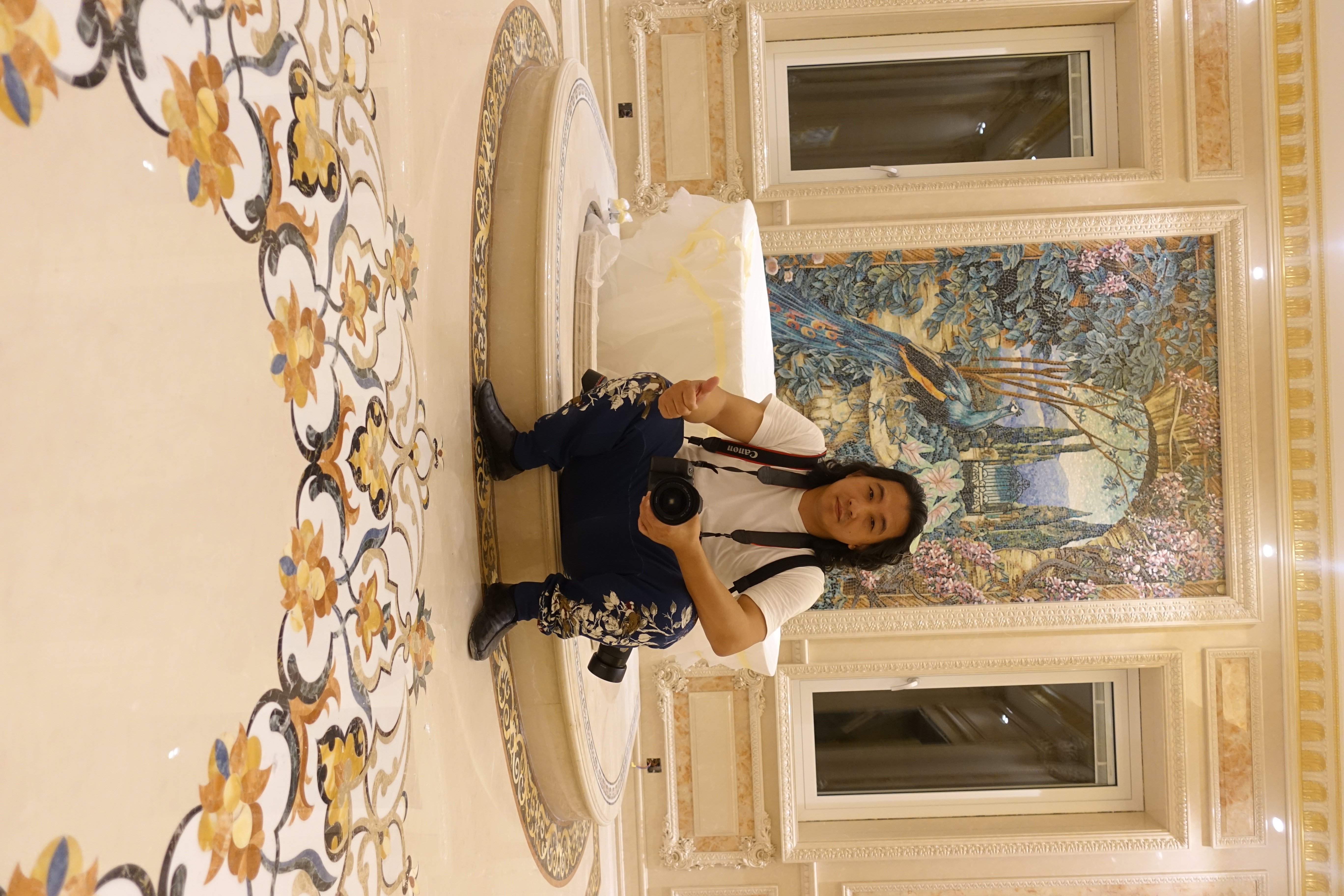
For formal majlis rooms seeking an opulent, organic atmosphere, floral arabesques incorporate authentic semi-precious hardstones. Petals, acanthus scrolls, and central rosettes are crafted from genuine Afghan Lapis Lazuli, African Malachite, Indian Green Onyx, and iridescent Mother of Pearl. Each gemstone is cut and hand-dressed by master lapidaries before bench insertion. Read more about historical and modern techniques in our complete guide to authentic pietre dure.
5. Turnkey Logistics: Atelier to Site Delivery (CIF & DAP)
Ordering factory-direct from our Jiangmen atelier removes domestic showroom distributor markups (saving 40%–60% on project budgets) while providing complete turnkey export logistics to the Middle East:
- 100% Factory Dry-Dock Assembly: Before a single crate is built, the entire majlis floor is laid out across our dry-assembly floor. Orthogonal high-resolution photography and an interactive 4K video survey are submitted to your architectural team for final sign-off.
- Numbered Puzzle-Piece Crating: Medallions larger than 2.4 meters are divided into interlocking modular sectors (typically 800mm to 1,200mm segments) that two local workers can easily handle on site. The hidden underside of each panel is stamped with alphanumeric coordinates corresponding to a laminated 1:1 CAD setting roadmap.
- ISPM-15 Certified Crating: Stone panels are cushioned with high-density EVA shock-absorbing foam inside heavy fumigated plywood export crates.
- Customs & Port Clearance: We ship CIF to Jeddah Islamic Port, King Abdulaziz Port in Dammam, Jebel Ali Port in Dubai, or Hamad Port in Qatar, or provide turnkey DAP delivery directly to your job site with complete SABER/SASO certification and commercial invoices.
Frequently Asked Questions: Royal Majlis Inlay Specification
What is the typical pricing for a custom marble inlay floor in a Saudi or UAE Majlis?
Factory-direct fabrication pricing for bespoke majlis waterjet marble flooring typically ranges from SAR 1,350 to SAR 4,500 per square meter (or AED 1,300 to AED 4,400 / m²; equivalent to $350–$1,200 USD/m²), depending on pattern density, stone rarity, and brass or semi-precious inclusions. Standalone grand medallions (3m to 6m) start from SAR 18,000 / AED 17,500 ($4,800 USD). Pricing includes full CAD shop drawings, factory dry-lay sign-off, and export crating.
Can local stone contractors in Riyadh or Dubai install Art Inlay panels easily?
Yes. The entire floor arrives pre-numbered with an accompanying 1:1 scale setting roadmap. Because all waterjet joints are cut to ±0.1mm tolerance, local stone masons simply lay the interlocking segments sequentially over standard flexible thin-set mortar. No on-site cutting or recutting is required.
How long does manufacturing and ocean freight to the Gulf take?
Standard fabrication takes 6 to 10 weeks following CAD shop-drawing and photographic slab approval. Ocean shipping from Shenzhen to Jebel Ali or Jeddah Port takes 14 to 18 days. Expedited air freight is available for time-critical palace inaugurations.
How do we begin the design and tender process?
Simply share your architectural floor plan (DWG, DXF, or PDF) along with any mood-board references. Within 48 hours, our engineering desk returns an initial shop drawing, stone schedule recommendation, and an itemized factory-direct tender quotation.
Tender & Quotation
Plan your Royal Majlis marble floor with direct atelier engineering
Send your architectural floor plan or concept sketch. We return a calibrated 1:1 CAD cut plan, photographic slab selection study, and an itemized factory-direct quote within 48 hours.