
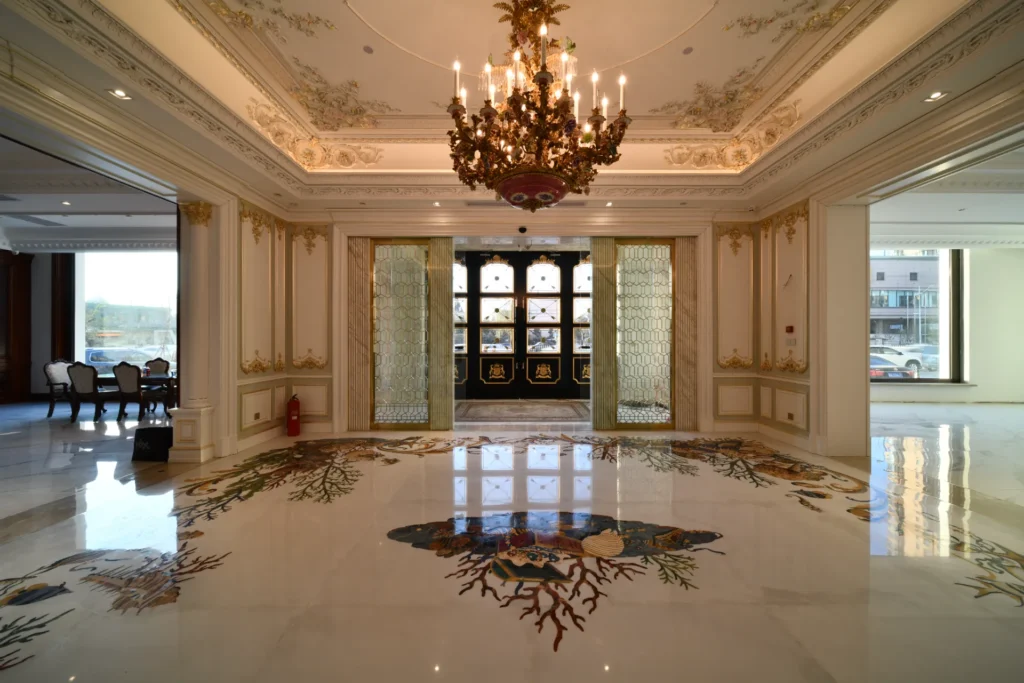
Italian marble inlay is the tradition behind almost every inlaid floor we make: the commesso and pietre dure of Florence, the geometric floors of the Renaissance, the church and palace pavements that survived centuries of footsteps. Understanding where the craft came from explains why the rules of good inlay, legible line, close joint, planned set-out, still hold today. This guide traces Italian inlay from its origins to the modern waterjet.
Start here. See inlaid marble flooring, pietre dure and what is pietre dure.
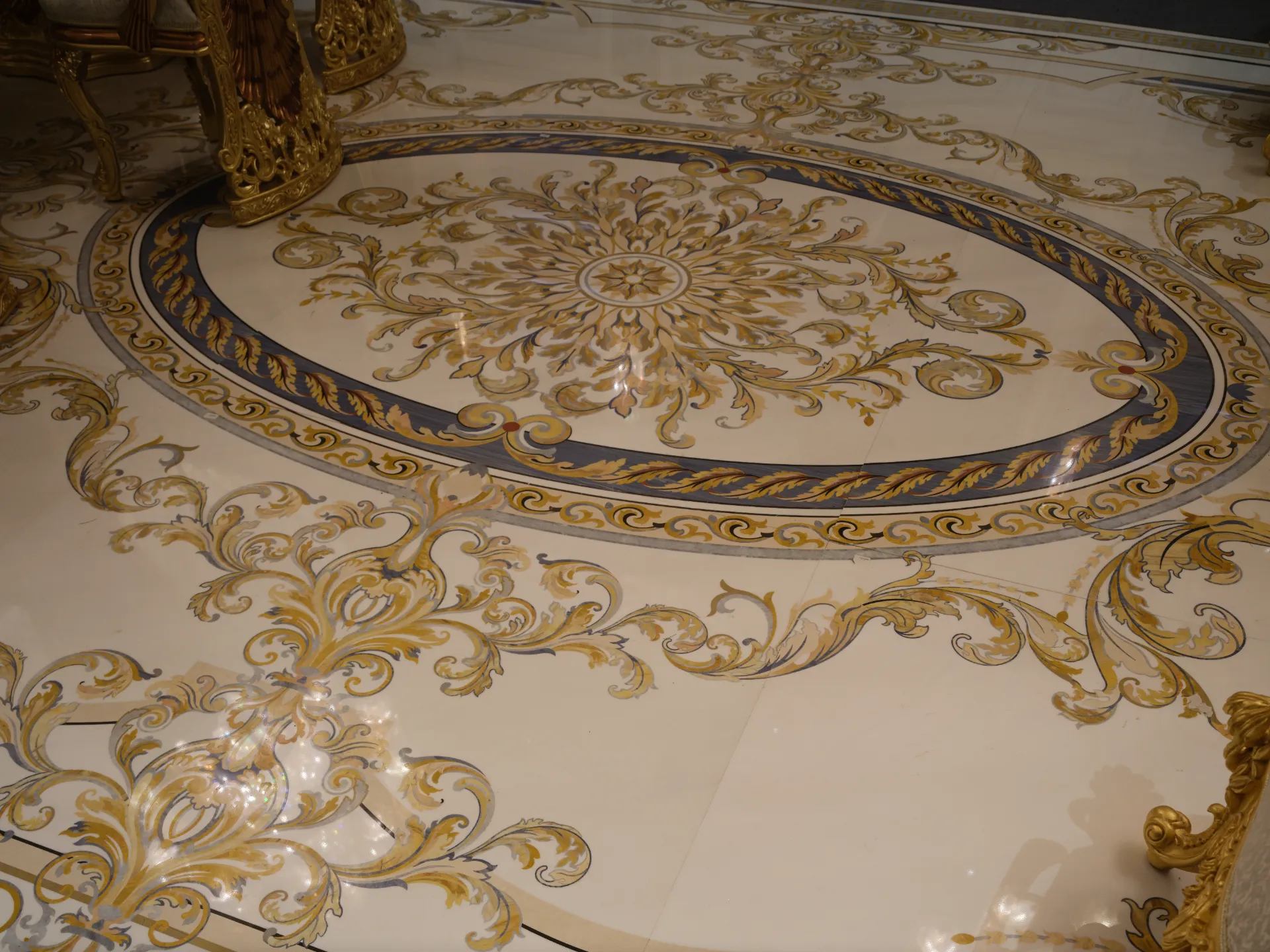
Where Italian inlay began
Stone inlay is older than Italy, Roman floors used coloured marbles cut and set, but the Italian tradition refined it into a system. By the fifteenth and sixteenth centuries, Cosimo de’ Medici had gathered craftsmen into a Florentine workshop, the Galleria dei Lavori, to master both the geometric floor (the commesso in marble) and the pictorial panel in semi-precious hardstone (pietre dure). That workshop, the Opificio delle Pietre Dure, still exists, and its name is shorthand for the finest work in the craft.
The grammar of Italian inlay
Italian pavements are built on a simple, durable grammar that is still the basis of a good floor:
- A field, a grid, a scaled geometric pattern or a running layout.
- A border, a band that frames the field and meets the walls.
- A figure, a medallion, a cartouche or a pictorial panel at the centre.
- A joint, closed so tightly the surface reads as one stone.
Every element is set out to the architecture; nothing is left to the tile module. This is why a Renaissance pavement still looks resolved where a modern copy of the pattern does not: the composition was drawn to the room.

Pietre dure: painting in stone
The Italian genius for the material was the pietre dure panel, pictures built from lapis, malachite, jasper and agate, each stone chosen for the vein that would read as shadow or plumage. It supplied the colour that plain marble could not. Today the same instinct drives our pietre dure collection and the semiprecious feature walls that descend from it.
From Florence to the waterjet
The tools have changed, the discipline has not. Where the Florentine workshop cut with a bow saw and abrasive, we cut with a multi-axis waterjet from an approved CAD drawing, held to ±0.1 mm. But the handwork that defines the tradition remains: stones are chosen against the drawing, the panel is dry-assembled and photographed for approval, the joints are closed by hand, and the finished floor ships numbered with a setting plan. See waterjet marble cutting and our manufacturing process.

Why specify Italian-style inlay
- It lasts. Properly set inlay is a permanent floor; the joint, not the style, is what fails in cheap work.
- It is architectural. Because it is drawn to the room, it suits the space rather than decorating over it.
- It mixes with the modern. A geometric Italian field in two stones is as at home in a contemporary interior as in a classical one.
Frequently asked questions
Is “Italian marble inlay” a specific stone?
No, it describes the tradition and method, not a single marble. The stones are chosen per project.
Is it the same as pietre dure?
Pietre dure is one branch of the Italian tradition: pictorial work in semi-precious hardstone. Geometric floors are the other.
Can you match a historic pavement?
Often, send a straight-on photograph with a reference measurement and we will reverse-engineer the pattern and set-out.
Does it work in modern buildings?
Yes, including with underfloor heating; movement is engineered into the cut plan.
Commissions
Start an Italian inlay commission
Send a drawing or a photograph, we return a technical material study, a cut plan and an itemised quote within three working days.