
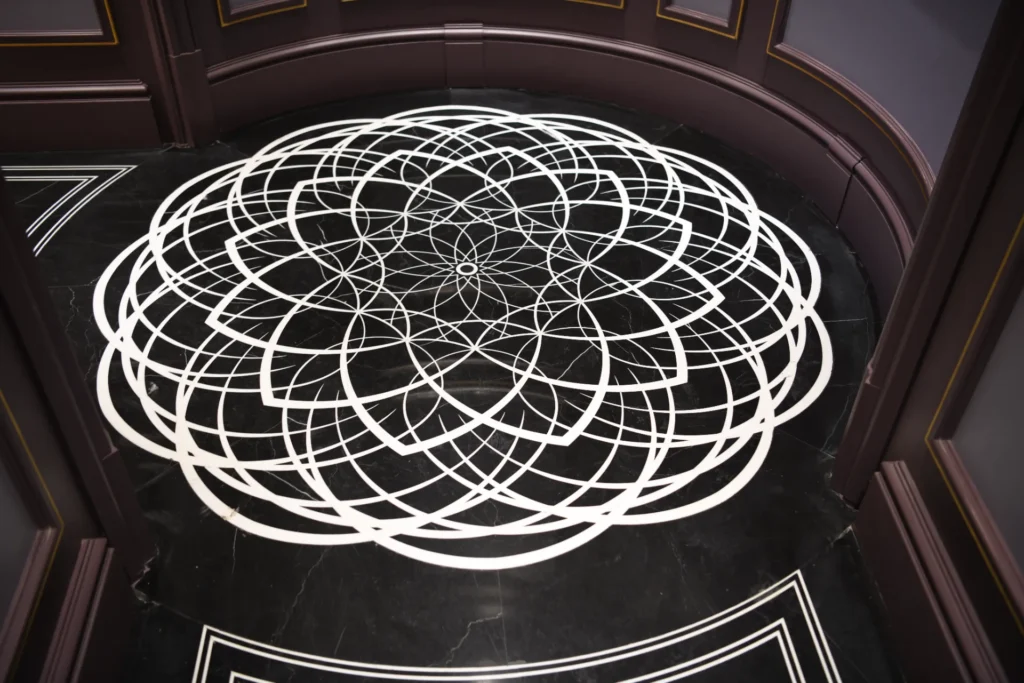
Waterjet cutting is how a drawing becomes thousands of precisely shaped marble pieces that close together with no visible grout line. Unlike a saw, a waterjet never touches the stone with a blade, a stream of water at up to 6,000 bar, mixed with abrasive garnet, cuts through marble, granite, brass and semi-precious stone along any path the drawing defines. This guide explains how waterjet marble cutting works, how precise it really is, what it can and cannot do, and what drives the cost.
Start here. This is part of our technical library. For the finished work see marble medallions, inlaid marble flooring and pietre dure; for how the pieces fit together on site read the installation manual and the specifier’s guide.
What a waterjet actually does
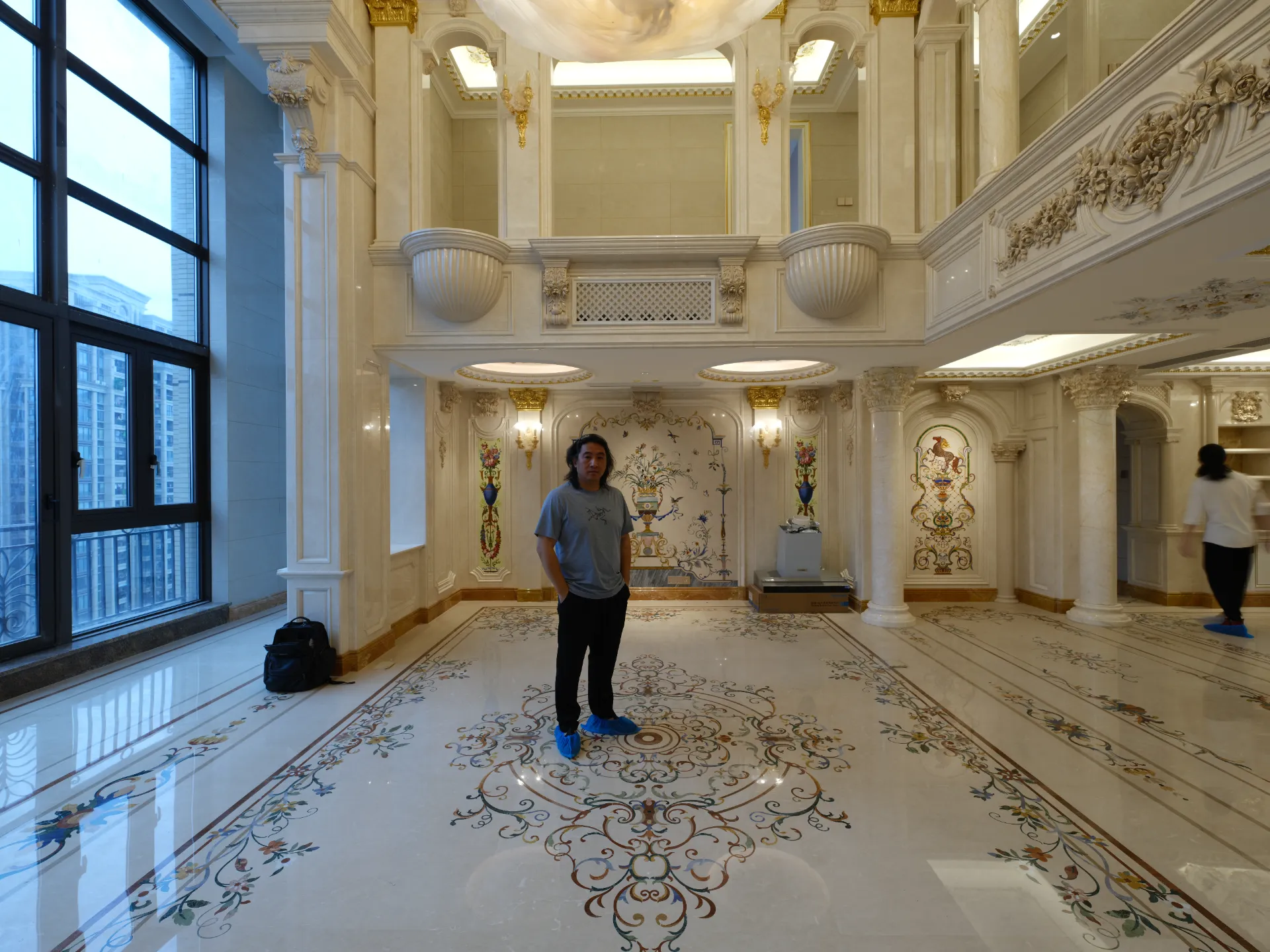
A waterjet is a cutting machine with no blade and no heat. A high-pressure pump forces water through a tiny jewel orifice, and abrasive garnet is drawn into the stream to give it cutting power. The head moves on a gantry guided by the same CAD data an architect already holds, so what is drawn is what is cut.
That matters for inlay. Inlay is not a single sheet of stone with a pattern printed or painted on top, it is a picture or a geometry built from individual pieces, each cut to a shape and fitted to its neighbours. The tighter the fit, the more the finished surface reads as one continuous stone. Waterjet cutting is the only practical way to achieve that fit at the scale of a full floor or a six-metre medallion.
How the waterjet marble cutting process works
1. Design and CAD engineering
Every commission begins as a full-size drawing. We redraw it as clean vector geometry in CAD, decide where the joints will fall, allow for the kerf, and plan the setting-out so the pattern lands correctly against the walls and openings. Nothing is cut until the drawing is approved.
2. Nesting and kerf planning
Kerf is the width of stone the water stream removes, typically 0.8–1.2 mm with abrasive. In inlay, kerf is not waste to be minimised: it is the tolerance that lets thousands of pieces meet without gaps or overlaps. We nest the pieces on each slab to use the material well and to keep the veining running the way the design intends.
3. Cutting
The machine follows the file, piece by piece, through marble, granite, onyx, semi-precious hardstone and even brass or stainless fillets. Because cutting is cold, there is no heat-affected zone and no scorching, important with stones that discolour under heat.
4. Dry assembly
After cutting, the full composition is assembled dry on our floor, inspected for fit and colour, and photographed for the client’s approval. Only then is it numbered, crated and shipped with a setting plan.
How precise is waterjet cutting?
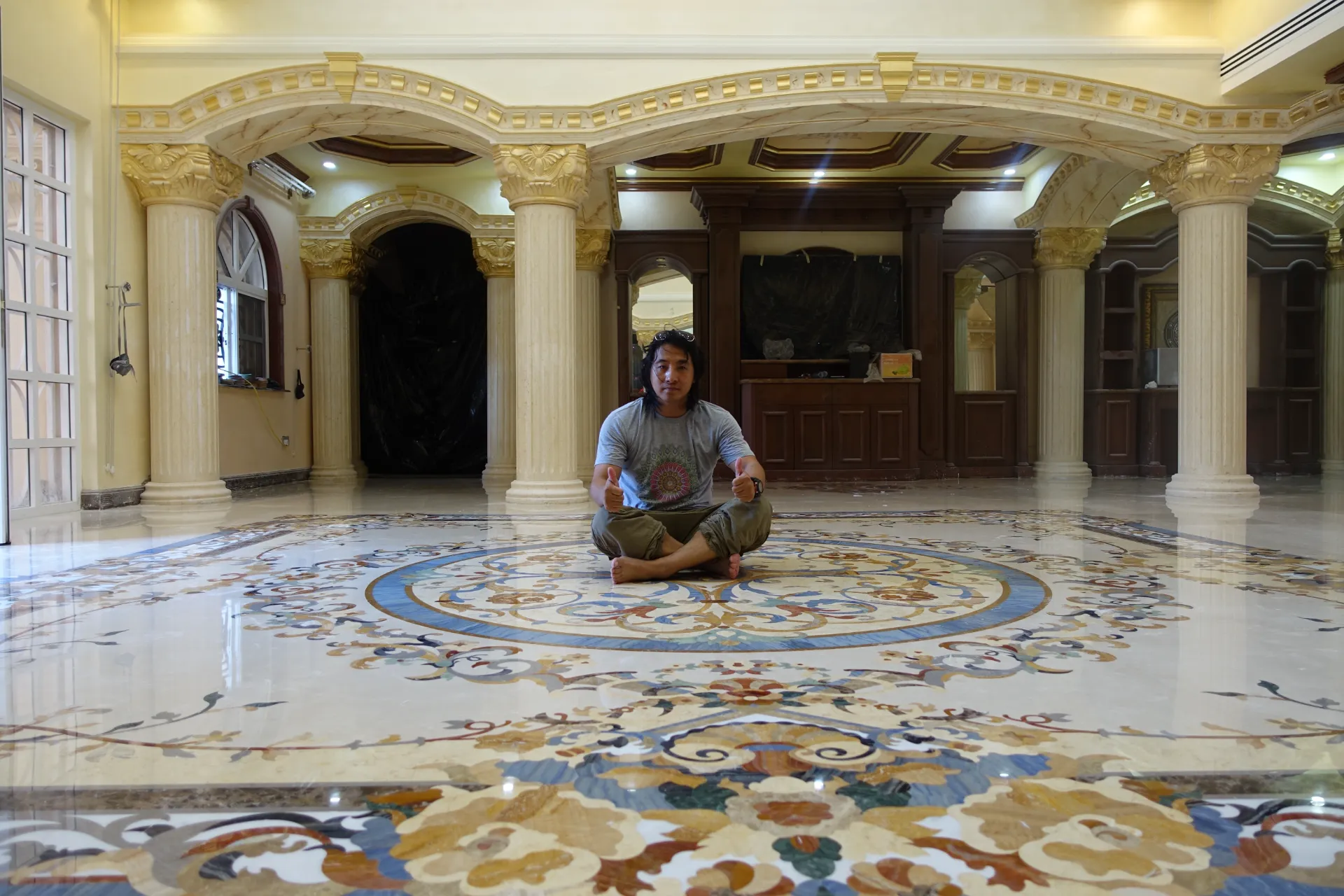
A modern multi-axis waterjet holds a positional accuracy of about ±0.1 mm across a large figure. In practice the limit is not the machine but the stone: some marbles chip at the edge, some are friable, and very thin slivers can only be cut so fine before they become fragile. We design around the material so the finished joint closes to a hairline rather than a grout line.
Two numbers matter when you specify:
- Tolerance, how far a cut can stray from the drawing (±0.1 mm target).
- Kerf / joint, how much material the cut removes, and therefore how wide the final joint is once the epoxy closure is polished (often a 0.8 mm joint on pictorial pietre dure).
What a waterjet can cut
Almost anything hard and cuttable: Calacatta, Statuario, Nero Marquina, Verde Alpi, Rosso Levanto, travertine, onyx and granite; semi-precious hardstone such as lapis lazuli, malachite, jasper, agate and mother-of-pearl; and metals for fillets, brass, stainless steel and copper. Because the same file drives every material, a brass line can be cut to sit exactly inside a marble pattern.
Waterjet vs other ways to cut stone
Waterjet vs bridge saw
A bridge saw cuts straight lines and simple angles. It is fast and cheap for tiles and slabs, but it cannot follow the curves and fine detail an inlay pattern needs.
Waterjet vs laser
Lasers struggle with thick stone and can scorch or glaze an edge. The waterjet is cold, so colour and surface are unaffected, and it handles full slab thicknesses.
Waterjet vs CNC router
A router removes material with a spinning bit and can chip brittle stone or struggle with internal corners. The waterjet reaches every edge from any direction with a uniform kerf.
Waterjet vs mosaic
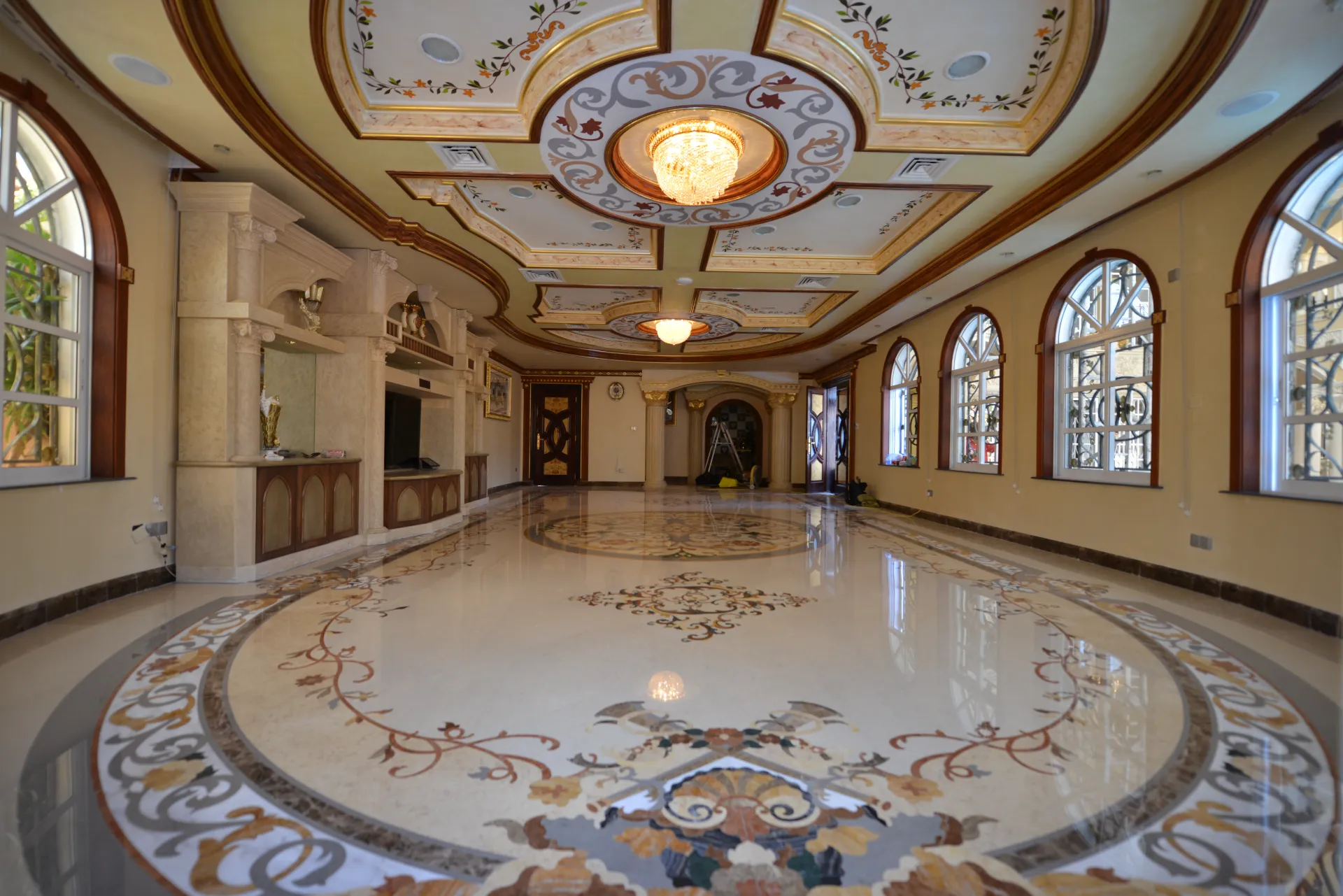
Mosaic sets many small, roughly uniform pieces with visible grout. Waterjet inlay cuts larger, individual pieces to a CAD file and closes the joints to a hairline, so the design reads as one surface. If the look you want is a true seamless picture, it is inlay, not mosaic.
What drives the cost of waterjet marble cutting
There is no flat price per square metre for bespoke inlay, because two floors of the same size can differ enormously in work. The cost is driven by:
- Cut length, not area. A dense pattern has far more edges than a plain one, a floral floor can cost several times a geometric one of the same size.
- Material. Calacatta and semi-precious stones cost more than a common marble, and fragile stones cut slower.
- Piece size and count. Hundreds of small pieces take longer to cut, assemble, number and lay than a few large panels.
- Finishing. Polishing, backing and edge treatment add labour.
- Site and logistics. Export crating, shipping and the setting plan are part of the price.
For an honest number, send a drawing: we return a material study, a cut plan and an itemised quote, see our guide to what drives marble inlay cost.
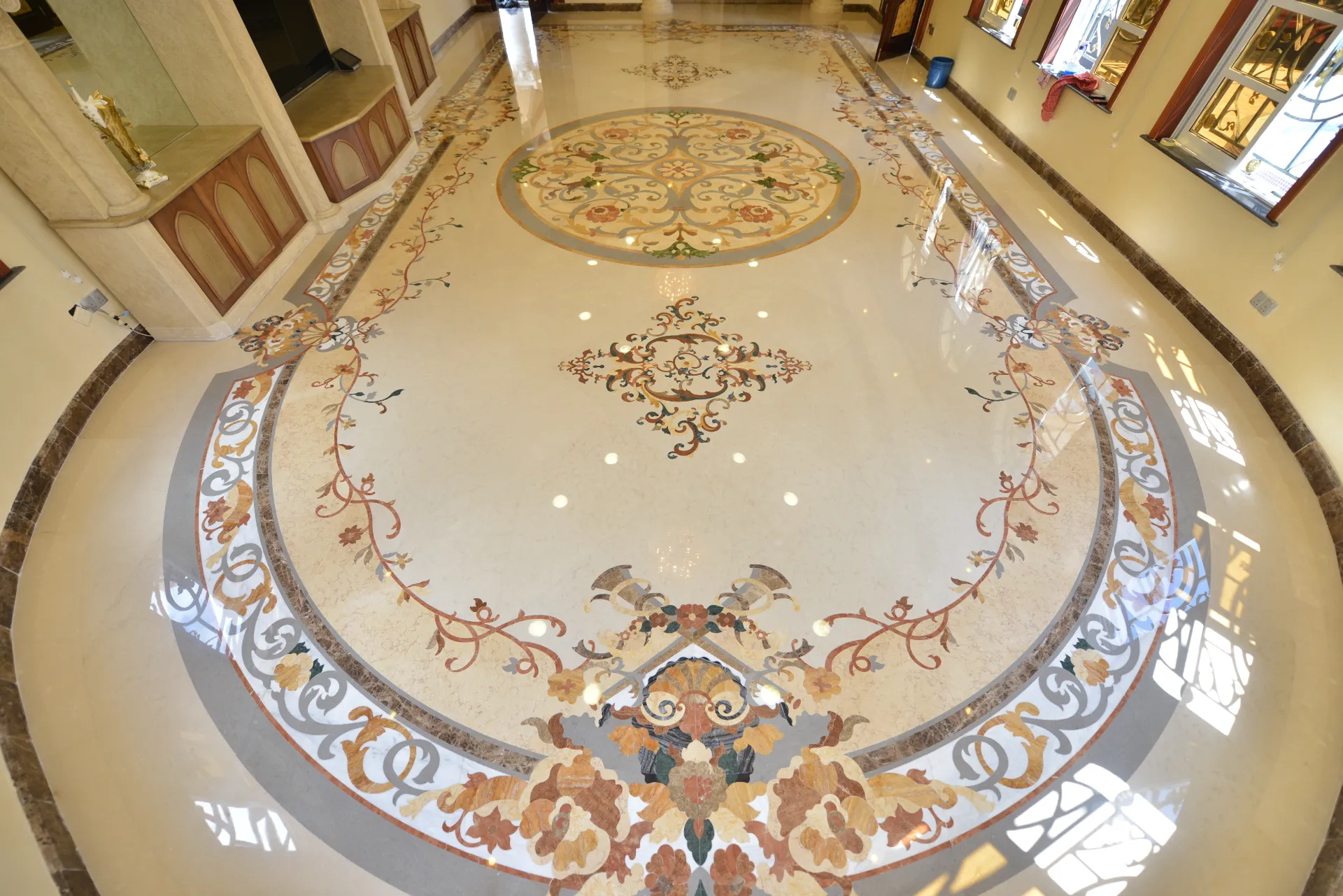
Where waterjet marble is used
Entrance floors and foyers, hotel lobbies, medallions and centrepieces, borders and accent bands, bathroom and spa floors, wall panels and feature walls, stair halls, table tops and pietre dure artwork. The same cutting is used whether the piece is a 300 mm border tile or a 6-metre floor composition.
Frequently asked questions
Can any waterjet shop cut marble inlay?
A waterjet is widely available, but inlay is a tolerance and assembly discipline, not just a cutting service. The difference is in the dry assembly, the numbering and the setting plan, pieces cut separately must still fit when they arrive.
How thick is the stone?
18 mm is standard for floors; heavier traffic or certain substrates call for 20 mm. Wall panels and light-weight applications can be thinner on a honeycomb backing.
Can you cut the pattern on site?
We cut, dry-assemble, photograph and number every panel before shipping, so the pieces drop in on site. Touch-ups and the occasional re-cut are covered in the installation manual.
Will there be a visible grout line?
No. The joints close to a hairline and are finished with colour-matched stone epoxy, then polished as one surface.
Do you cut brass and stone together?
Yes, the same file drives both, so brass fillets sit precisely inside the marble pattern.
Commissions
Start a waterjet marble project
Send a drawing or a photograph, we return a technical material study, a cut plan and an itemised quote within three working days.