
What Is Waterjet Marble Cutting? (Executive Summary)
Waterjet marble cutting is a non-thermal, precision CNC machining process that uses an ultra-high-pressure stream of water (40,000 to 60,000+ PSI / 2,750 to 4,100+ bar) mixed with fine abrasive garnet (80 to 120 mesh) traveling at speeds up to Mach 3 through a tungsten carbide nozzle (0.76mm to 1.02mm orifice). It erodes stone along programmed 5-axis toolpaths with microscopic accuracy (±0.1 mm). Because it generates Zero Heat-Affected Zone (HAZ), waterjet cutting eliminates thermal cracking, preserves delicate veining in brittle marbles, and produces hair-thin kerf widths (0.8mm–1.0mm) necessary for flawless architectural stone inlay and bookmatched medallions.
Technical Review: Wang Fei (Bruce) · Quality Standards: ASTM C880, ASTM C99, NSI Dimension Stone Standards · Art Inlay Atelier, Jiangmen, China.
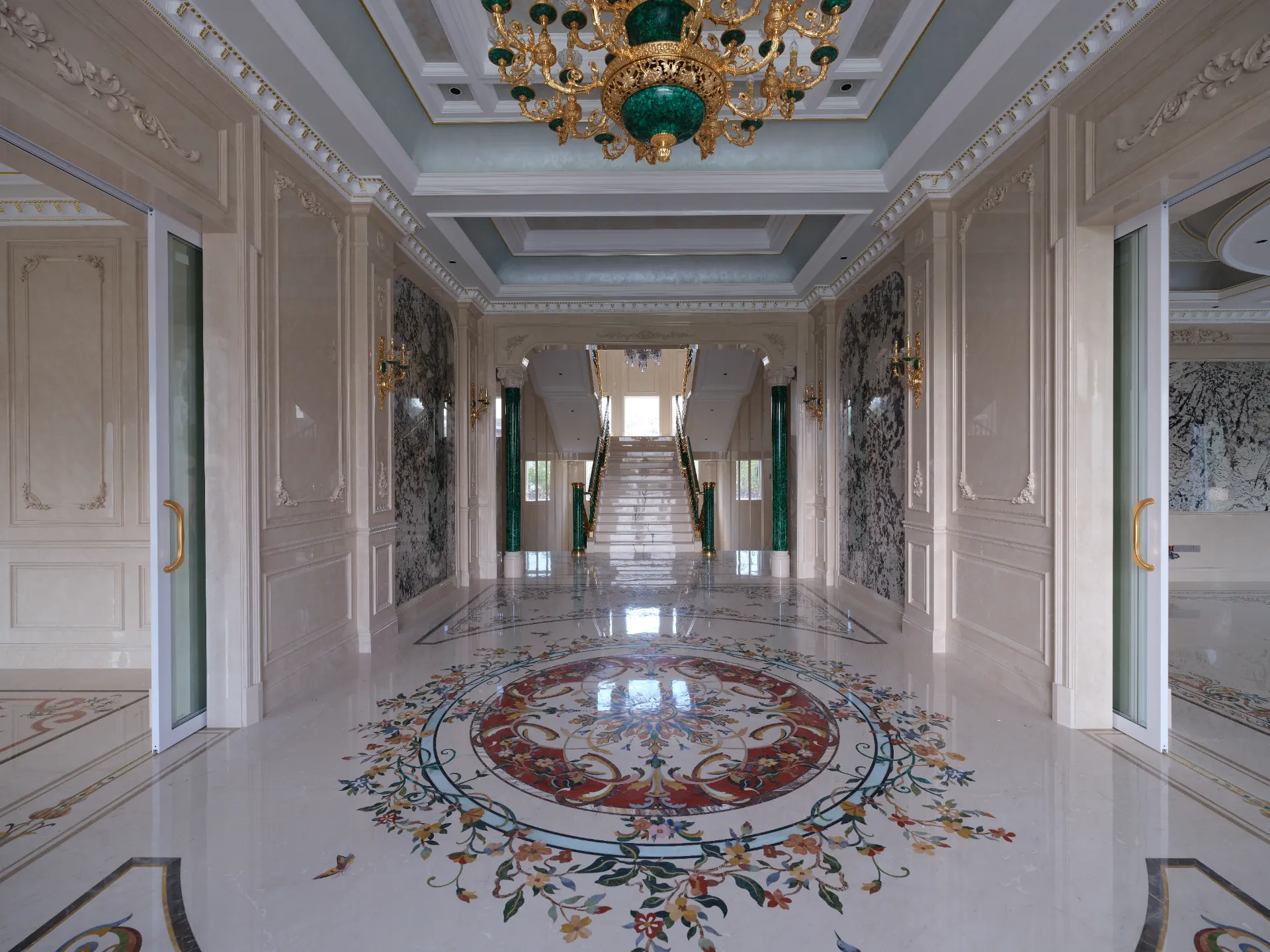
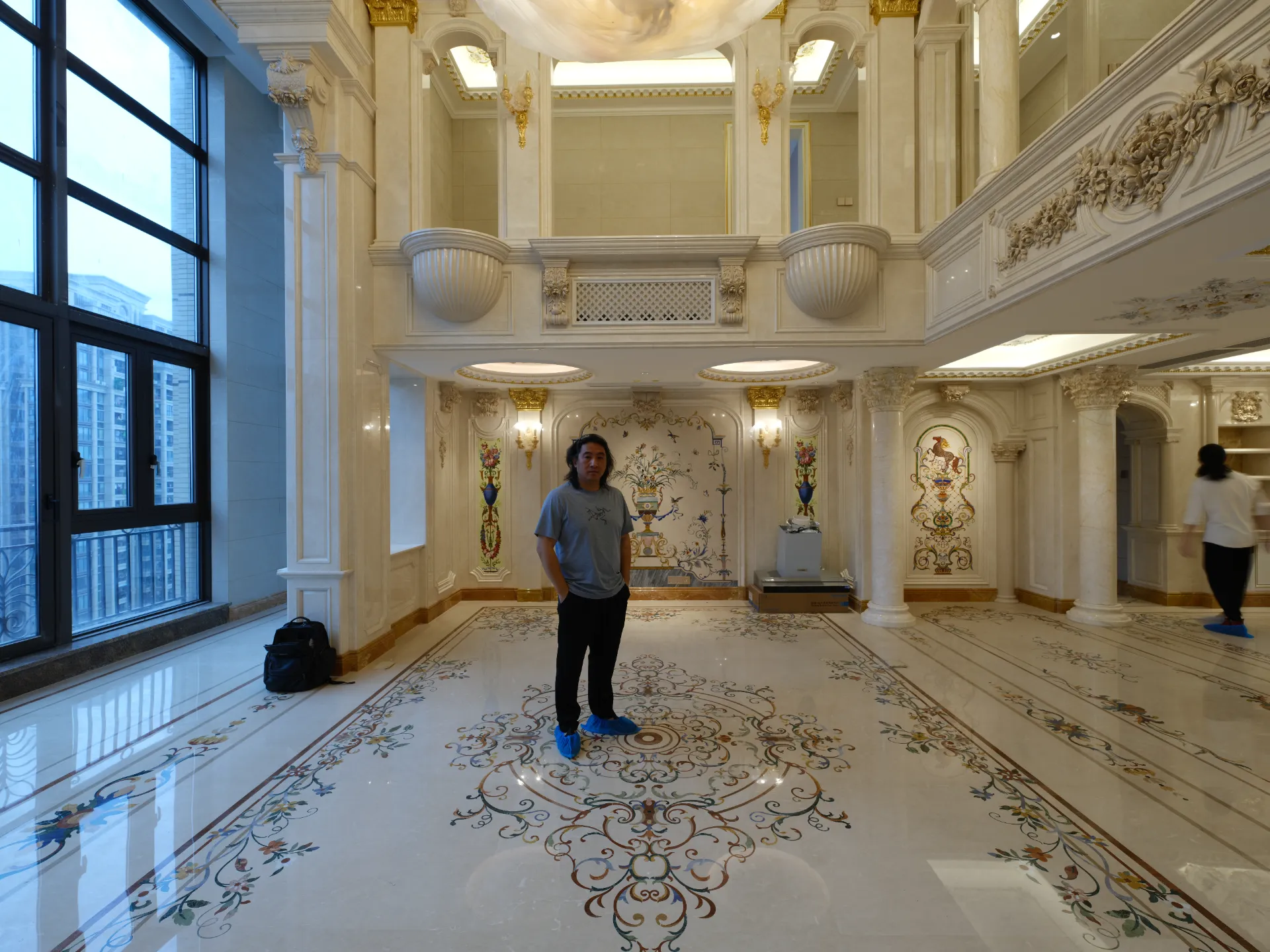
Waterjet marble cutting is the technological foundation of modern bespoke architectural stonework. From monumental 6-meter palace medallions in Riyadh and geometric floor borders in Mayfair penthouses to seamless marble inlay dining tables in Manhattan, abrasive waterjet (AWJ) cutting transforms raw metamorphic stone into microscopically matched architectural components without thermal shock, structural micro-fracturing, or edge spalling.
Start Here — Art Inlay Technical Resource Library
Explore how we apply precision waterjet cutting to our architectural collections: view our Custom Marble Medallions Collection, inspect our continuous Inlaid Marble Flooring, and browse Waterjet Marble Borders & Accents. For installation and structural tolerances, review our Installation Manual and Architectural Specification TDS.
However, specifying or supervising custom waterjet marble work requires a deep understanding of hydraulic physics and stone petrology. Marble is not a homogeneous metal alloy; it is a natural, crystalline metamorphic rock laced with calcite veins, varying fissure planes, and distinct Mohs hardness ratings. Without precise control over pump intensifier pressures, abrasive feed metering, kerf taper compensation, and low-pressure piercing sequences, high-pressure waterjets can shatter brittle stones or produce tapered edges that prevent tight, monolithic inlay joints.
Drawing upon 18+ years of factory floor engineering and global project delivery at our Jiangmen atelier, this comprehensive architectural guide examines the inner mechanics of abrasive waterjet cutting: from 60,000 PSI pump kinematics and 5-axis taper compensation to real-world fabrication cost matrices, stone yield optimization, and zero-grout assembly standards.

1. The Physics & Mechanical Anatomy of Abrasive Waterjet (AWJ) Cutting
To understand why waterjet cutting is the only sanctioned cutting method for bespoke pietra dura and architectural marble inlay, one must examine the fluid dynamics at the cutting head. Unlike diamond gang saws, bridge saws, or CNC milling routers, a waterjet performs supersonic micro-erosion.
                        HIGH-PRESSURE WATER INLET
                       [ 60,000 PSI / 4,136 Bar ]
                                   │
                                   ▼
                       ┌───────────────────────┐
                       │ DIAMOND ORIFICE JEWEL │  (0.25mm - 0.35mm Dia.)
                       └───────────────────────┘
                                   │
                       [ Coherent Supersonic Stream ] (Mach 2.5 - Mach 3)
                                   │
  GARNET ABRASIVE INLET ───────────┼─────────── VENTURI MIXING CHAMBER
  (80-Mesh Barton Garnet)          │            (Partial Vacuum Draws Garnet)
                                   ▼
                       ┌───────────────────────┐
                       │ TUNGSTEN CARBIDE      │
                       │ MIXING TUBE / NOZZLE  │  (0.76mm - 1.02mm Dia. × 76mm L)
                       └───────────────────────┘
                                   │
                                   ▼
                 ═════════════════════════════════  <= NATURAL MARBLE SLAB
                     KERF WIDTH: 0.8mm - 1.0mm         (Zero Heat, Pure Shear Erosion)
                 ═════════════════════════════════
The Three Core Mechanical Subsystems
- Ultra-High Pressure Generation (Intensifier vs. Direct Drive Pumps):
- Hydraulic Intensifier Pumps (Recommended for Marble): A hydraulic cylinder driving dual opposing plunger pistons creates pressures from 55,000 PSI to 94,000 PSI (3,800 to 6,500 bar). Intensifier pumps provide smooth pressure transitions via an accumulator bottle, drastically reducing pressure pulsation spikes that could shock and micro-fracture crystalline calcite slabs.
- Direct Drive Crankshaft Pumps: Highly energy-efficient for continuous metal slicing, but direct drive pumps produce slight pressure ripple frequencies that require dampening when cutting sensitive semi-precious minerals (lapis lazuli, malachite, green onyx).
- The Supersonic Orifice & Venturi Mixing Chamber:
- Pure filtered water enters the cutting head and is forced through a synthetic sapphire or ruby jewel orifice (typically 0.25mm to 0.35mm / 0.010″ to 0.014″ diameter).
- As the water discharges into the mixing chamber at Mach 2.5 to Mach 3, it generates a high-velocity venturi vacuum.
- This vacuum pulls precisely measured abrasive mineral grains from an automated hopper into the chamber.
- Abrasive Acceleration in the Tungsten Carbide Nozzle:
- The mixture of supersonic water and abrasive garnet enters a tungsten carbide focusing nozzle (typically 0.76mm to 1.02mm / 0.030″ to 0.040″ internal diameter, 76mm length).
- Within this tube, the water transfers kinetic energy to the garnet particles. The stream exits the nozzle as a focused, razor-sharp erosion column with an effective kerf (cut width) of roughly 0.8mm to 1.0mm.
Why Zero Heat-Affected Zone (HAZ) Is Critical for Marble
Traditional diamond blades create intense frictional heat at the contact point. Even with flood cooling, diamond saws generate localized thermal gradients in marble. Because calcite (CaCO3) has an anisotropic thermal expansion coefficient (expanding in one crystal axis while contracting in another), heat causes thermal cleavage along microscopic calcite boundaries. This leads to micro-spalling, yellowing of white marbles (such as Thassos or Bianco Carrara), and hairline surface fractures that fail months after installation. Waterjet cutting operates at ambient water temperature, transferring zero thermal stress to the stone.
2. Machining Kinematics: 3-Axis vs. 5-Axis Dynamic Taper Compensation
In standard 3-axis waterjet cutting, the cutting head remains fixed perpendicular to the table. While adequate for rough slab blocking or metal blanking, a fixed 90° head has two inherent hydro-abrasive physics limitations: Kerf Taper and Stream Lag (Trailback).
       3-AXIS FIXED HEAD (V-Taper Defect)              5-AXIS DYNAMIC HEAD (True 90° Edge)

                 │  Nozzle                                      \  Nozzle (Tilted 1.5° - 3°)
                 │                                               \
          ┌──────┴──────┐                                 ┌───────\─────┐
          │             │                                 │        \    │
  Top ───►│ ─── 0.9mm ──│                                 │ ── 0.9mm ── │ ◄── Top
          │   \     /   │  <= V-Shape Taper               │  │       │  │
          │    \   /    │     (Top wider than             │  │       │  │  <= True 90°
  Bottom─►│ ─── 0.7mm ──│      bottom)                    │  │       │  │     Cylindrical Wall
          └─────────────┘                                 └──┴───────┴──┘
           Result: Inlay pieces fail to                    Result: Microscopic drop-in fit,
           fit flush; wide top gaps.                       zero gaps, monolithic surface.
Understanding Kerf Taper & Stream Lag
- Kerf Taper: As the supersonic jet penetrates downward through a 20mm marble slab, the abrasive particles lose kinetic energy. The jet widens slightly at the entry and narrows toward the exit, creating a “V-shaped” cross-section where the cut piece is 0.15mm to 0.3mm narrower at the bottom than at the top.
- Stream Lag (Trailback): As the CNC gantry advances along a curve or sharp geometric corner, the bottom of the water jet trails behind the top of the jet. On acute star points or curvilinear floral scrolls, this lag causes gouging or round-off on the underside of the stone.
How Art Inlay’s 5-Axis Dynamic Waterjets Eliminate Taper
To manufacture museum-grade pietra dura and palatial medallions, our atelier operates 5-axis dynamic cutting heads:
- Real-Time Mathematical Taper Angle Tilting: Advanced CAM software calculates the instantaneous velocity, stone hardness, and thickness, tilting the cutting nozzle between 1.5° and 4.0° off-vertical. The natural V-taper of the water stream is pushed entirely into the scrap material (the drop), leaving the finished inlay component with a perfect 90.0° perpendicular edge.
- Speed-Lookahead Cornering: When the toolpath approaches an acute corner (e.g., an 8-point Islamic star or Vitruvian wave), the 5-axis head articulates dynamically, decelerating and pivoting to ensure the jet’s exit point aligns vertically with its entry point before changing direction.
- The Architectural Consequence: With 5-axis dynamic compensation, adjacent pieces of contrasting marble (e.g., Belgian Black and Thassos White) drop together like precision puzzle pieces with an edge joint tolerance under ±0.1mm (0.004″).
Comparison: Marble Cutting Technologies
| Machining Method | Typical Kerf Width | Cutting Tolerance | Edge Squareness (Taper) | Heat Affected Zone (HAZ) | Micro-Fracture Risk | Best Architectural Application |
|---|---|---|---|---|---|---|
| 5-Axis Dynamic AWJ (Art Inlay) | 0.8mm – 1.0mm | ±0.08mm to ±0.12mm | True 90° (0.0° taper) | None (Ambient water) | Near Zero | Bespoke medallions, fine pietre dure, brass/stone hybrid inlay |
| Standard 3-Axis Waterjet | 0.9mm – 1.2mm | ±0.3mm to ±0.5mm | 1.5° – 3.0° V-taper | None | Low | Coarse geometric tiles, perimeter step treads, slab sizing |
| CNC Diamond Milling Router | 3.0mm – 8.0mm | ±0.2mm to ±0.4mm | 90° (Rigid tool) | Moderate (Tool friction) | Moderate | Bas-relief architectural carving, fluting, heavy profiling |
| Diamond Wire Saw | 1.5mm – 2.5mm | ±0.5mm to ±1.0mm | High bow deflection | Low (Flooded) | Low to Medium | Primary block squaring, monumental architectural columns |
| Manual Hand Chisel / Lapidary | Variable | ±1.0mm to ±2.0mm | Irregular undercut | None | High (Impact shock) | Traditional historic restoration, rustic hand-sculpted finishes |
3. Stone Petrology: Pressure, Piercing & Brittleness Management
Marble is not uniform. A cutting program calibrated for a dense dolomitic marble (such as Thassos Pure White) will destroy a delicate, multi-veined breccia or calcite onyx. At Art Inlay, stone petrology determines our cutting parameters.
                    MOHS HARDNESS & WATERJET CUTTING VELOCITY SPECTRUM

  [ FRAGILE / SOFT CALCITIC ]     [ DENSE METAMORPHIC ]     [ HARD DOLOMITIC ]     [ ULTRA-HARD SILICATES ]
  Mohs: 2.5 - 3.2                 Mohs: 3.5 - 4.0           Mohs: 4.5 - 5.5        Mohs: 6.0 - 7.0
  Examples:                       Examples:                 Examples:              Examples:
  * Honey Onyx                    * Bianco Carrara          * Thassos White        * Blue Bahia Granite
  * Rosa Portogallo               * Nero Marquina           * Crema Marfil         * Brazilian Quartzite
  * Calacatta Viola               * Dark Emperador          * Verde Alpi           * Sodalite / Lapis
  ─────────────────────────────   ───────────────────────   ────────────────────   ────────────────────────
  Jet Pressure: 35-42k PSI        Pressure: 50-55k PSI      Pressure: 55-60k PSI   Pressure: 60-65k PSI
  Abrasive: 100/120 Mesh Fine     Abrasive: 80 Mesh Std     Abrasive: 80 Mesh Std  Abrasive: 60/80 Mesh Coarse
  Pierce: Vacuum Soft Start       Pierce: Linear Ramp       Pierce: Direct Dynamic Pierce: Heavy Dynamic
The Critical Piercing Sequence: Eliminating “Blowout”
The most perilous moment in waterjet stone cutting is the initial pierce—the millisecond when the stationary water jet breaks through the solid slab before moving along the vector toolpath.
- The Blowout Hazard: If 60,000 PSI of water strikes a solid marble slab before the abrasive garnet stream has fully established, the water enters natural micro-fissures and calcite cleavages. The trapped hydraulic pressure expands violently, causing a subsurface spall known as blowout or cratering, instantly destroying a $2,000 slab of Calacatta Gold or Honey Onyx.
- Art Inlay’s 3-Step Low-Pressure Vacuum Piercing Protocol:
- Low-Pressure Soft Start (10,000 to 15,000 PSI): The pump throttles down to low pressure while the abrasive valve opens simultaneously, ensuring garnet arrives at the stone face before high hydraulic pressure builds.
- Vacuum-Assisted Abrasive Induction: An active vacuum inducer pulls garnet directly into the nozzle, eliminating the momentary dry-water shock.
- Ramped Pressure Transition: Once a micro-pilot hole is pierced through the 20mm thickness, the intensifier ramps smoothly to operating pressure (55,000–60,000 PSI) and begins cutting along a lead-in tangent line located in the scrap zone outside the finished geometry.
Submerged Waterbed Cutting vs. Above-Water Cutting
- Above-Water Cutting: Creates splashing, noise levels exceeding 95 dBA, and fine airborne mist. Crucially, the surface turbulence can deflect thin, delicate stone filigrees.
- Submerged Cutting (Atelier Standard): We submerge the marble slab 10mm to 20mm beneath the water table level. Submerged cutting dampens acoustic noise down to 72 dBA, suppresses abrasive fog entirely, and hydrostatically cushions delicate fretwork and slender 5mm botanical scroll stems, preventing them from vibrating or snapping under the lateral jet force.
4. Architectural Waterjet Marble Cutting Cost Matrix (2026–2027)
Budgeting for custom waterjet marble work is frequently misunderstood. Stone suppliers who quote solely on raw square footage often issue catastrophic change orders when intricate designs reach the fabrication floor. In professional architectural stone manufacturing, waterjet cutting cost is governed by linear cutting distance and machine cycle time, not square meters of slab.
                           THE FOUR COST DRIVERS OF WATERJET MARBLE

    [ 1. LINEAR CUTTING METERS ] ────► Total cutting path length per m² of floor.
    [ 2. STONE HARDNESS COEFFICIENT ] ► Cutting speed varies from 120 mm/min to 650 mm/min.
    [ 3. SLAB THICKNESS & KERF OFFSET ] 10mm tile vs 20mm solid vs 30mm curb.
    [ 4. YIELD LOSS (SCRAP RATIO) ] ──► Nesting efficiency varies from 45% (curvilinear) to 80% (square).
Factory-Direct Architectural Budgeting Matrix
The following benchmarks reflect factory-direct fabrication at Art Inlay’s atelier in Jiangmen for 20mm solid natural marble, including CNC programming, abrasive waterjet cutting, edge deburring, and dry-assembly:
| Complexity Category | Typical Architectural Applications | Linear Cutting Density (Meters / m²) | Cutting Feed Rate (20mm Marble) | Waterjet Machine Hours (per 10 m²) | Factory Cutting Cost per Linear Meter | Total Fabrication Cost per Sq Ft (Factory Direct) | Total Fabrication Cost per Sq Meter (Factory Direct) |
|---|---|---|---|---|---|---|---|
| Class A: Linear & Broad Geometric | Chevrons, octagons with contrast cabochons, 150mm Greek key borders | 6 – 12 lin. m / m² | 450 – 600 mm/min | 2.5 – 4.0 hrs | $4.50 – $7.00 | $26 – $42 / sq ft | $280 – $450 / m² |
| Class B: Neoclassical Scrolls & Rinceau | Baroque medallions, guilloche borders, acanthus leaf salon panels | 18 – 35 lin. m / m² | 280 – 400 mm/min | 7.5 – 12.0 hrs | $7.50 – $11.00 | $48 – $80 / sq ft | $510 – $860 / m² |
| Class C: Complex Arabesque & Majlis | 8/12/16-point Islamic stars, fine tessellations, calligraphy borders | 40 – 75 lin. m / m² | 180 – 260 mm/min | 16.0 – 24.0 hrs | $10.00 – $14.50 | $85 – $135 / sq ft | $910 – $1,450 / m² |
| Class D: Museum Pietre Dure & Micro-Inlay | Botanical pictorial panels, micro-feather shading, semi-precious stone fusion | 80 – 140+ lin. m / m² | 90 – 160 mm/min | 32.0 – 55.0 hrs | $15.00 – $24.00+ | $140 – $280+ / sq ft | $1,500 – $3,000+ / m² |
Machine Operating Cost Breakdown (Per Operating Hour)
When assessing fabricator quotes, verify that the facility utilizes premium garnet and maintained nozzles. A substandard shop cutting corners will use reprocessed abrasive or worn orifices, leading to jagged cuts and tapered edges.
- Abrasive Garnet (80-Mesh Australian/Adirondack Barton): 350 g/min = ~21 kg/hr @ $0.75/kg → $15.75 / hour
- Ultra-High Pressure Orifice & Nozzle Wear: Diamond orifice (500–800 hrs life) + Roctec carbide nozzle (80–120 hrs life) → $4.50 / hour
- High-Pressure Pump Seals & Check Valves: Periodic seal pack replacement → $3.20 / hour
- Electrical Power (50 HP / 37 kW Intensifier Motor): ~32 kWh @ industrial tariff → $4.80 / hour
- Deionized Chilled Water Consumption: 3.5 to 5.0 liters/minute → $0.90 / hour
- Direct Machine Operating Overhead: ~$29.15 / hour (excluding CAD/CAM nesting engineering and atelier hand-assembly craftsmanship).
5. From CAD DXF to Monolithic Masterpiece: The 6-Stage Atelier Workflow
Precision waterjet cutting represents only one link in an unbroken chain of craftsmanship. At Art Inlay, every architectural project transitions through six rigorous quality-controlled phases:
┌─────────────────┐     ┌─────────────────┐     ┌─────────────────┐
│ 1. CAD / BIM    │ ──► │ 2. NESTING &    │ ──► │ 3. 5-AXIS AWJ   │
│ VECTOR POLISHING│     │ VEIN SELECTION  │     │ PRECISION CUT   │
└─────────────────┘     └─────────────────┘     └─────────────────┘
                                                         │
                                                         ▼
┌─────────────────┐     ┌─────────────────┐     ┌─────────────────┐
│ 6. NUMBERED     │ ◄── │ 5. ZERO-GROUT   │ ◄── │ 4. ULTRASONIC   │
│ CRATING & EXPORT│     │ ATELIER DRY-FIT │     │ DEBURR & CLEAN  │
└─────────────────┘     └─────────────────┘     └─────────────────┘
Stage 1: Vector Clean-up & Kerf Offset Calibration
Architectural drawings submitted in DWG/DXF format are rarely machine-ready. Our technical specifiers clean spline geometry, convert overlapping polylines into continuous vector toolpaths, and apply kerf radius compensation. Because a waterjet stream has an effective cutting diameter of ~0.85mm, the machine centerpoint must be offset outward by exactly half the kerf width (0.425mm) on male inlay pieces, and inward on female host pockets.
Stage 2: Digital Slab Scanning & Vein-Flow Nesting
Before cutting, full stone slabs undergo high-resolution digital scanning on our calibrated photogrammetry table. Our CAD artisans nest the individual inlay puzzle pieces across the slabs: aligning natural marble veining across adjacent tiles to maintain uninterrupted movement across the room, positioning delicate star tips away from natural dry veins or soft stylolites that could crack during shipping, and nesting contrasting borders perpendicular to the field stone grain to heighten dramatic optical depth.
Stage 3: Dynamic 5-Axis Waterjet Fabrication
Slabs are loaded onto the waterjet cutting beds using pneumatic vacuum lifters. Stones are clamped under water, low-pressure pierced in scrap margins, and cut with 5-axis dynamic taper compensation at speeds tailored to the stone’s Mohs hardness.
Stage 4: Ultrasonic Cleaning & Edge Deburring
As pieces exit the cutting tank, they carry residual garnet slurry. Each component is immersed in an ultrasonic cleaning bath to purge abrasive particles from micro-pores, then hand-inspected under raking light. Master stonemasons gently dress the underside perimeter with 400-grit diamond pads to eliminate micro-burrs that could obstruct dry-fitting.
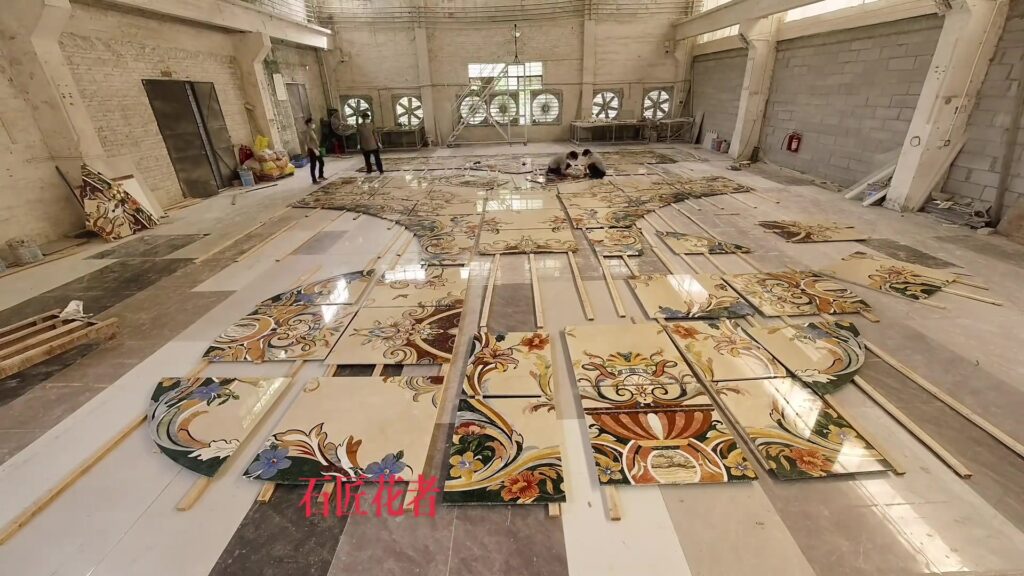
Stage 5: 100% Factory Dry-Assembly & Zero-Grout Resin Casting
In traditional tile work, installers rely on wide, unsightly 3mm grout joints to mask manufacturing errors. At Art Inlay, we believe grout ruins luxury marble inlay. We lay out the entire medallion or floor border—often spanning 50 to 300 square meters—on our atelier assembly floor. Every component is fitted edge-to-edge. Any joint exceeding 0.2mm is rejected and re-machined. Components are bonded into transportable interlocking modules (typically 600mm × 600mm to 1,200mm × 1,200mm) backed with aerospace-grade fiberglass mesh or solid aluminum honeycomb. Joints are filled with proprietary, UV-stable, color-matched polyester or epoxy liquid stone resin, then lapped flat with factory diamond planetary polishers to achieve a monolithic surface.
Stage 6: Keyed Modular Numbering & Museum Crating
The assembled floor is surveyed, photographed from an overhead crane camera, and drafted into a Keyed Setting-Out Installation Plan. Every module is labeled with an indelible reverse-side alphanumeric code (e.g., Grid A1 to H12). Modules are packed face-to-face with high-density EPE foam sheeting inside custom fumigated solid-plywood crates engineered to withstand international sea and air freight.
6. Architectural Specification & Quality Control Checklist
When drafting CSI Division 09 30 00 (Tiling) or Division 04 40 00 (Stone) specifications for luxury commercial or residential projects, incorporate the following enforceable clauses:
ARCHITECTURAL SPECIFICATION SUMMARY CLAUSES (WATERJET MARBLE INLAY)

1. CUTTING APPARATUS: All curvilinear and geometric stone inlay components shall be
   fabricated using computer-numerically-controlled (CNC) abrasive waterjet cutting
   machinery equipped with 5-axis active taper compensation. 3-axis fixed-head cutting
   exhibiting edge taper in excess of 0.2mm per 20mm thickness is strictly rejected.

2. CUTTING TOLERANCES: Fabricated stone inlay elements shall conform to dimensional
   tolerances of ±0.1mm (0.004") along all cut perimeters. Edge-to-edge fit between
   contrasting stone modules shall exhibit no gaps exceeding 0.3mm prior to resin bonding.

3. THERMAL INTEGRITY: Diamond blade dry-sawing or laser cutting of marble is prohibited.
   Cutting process shall produce Zero Heat-Affected Zone (HAZ) with no thermal micro-crazing.

4. DRY-FIT INSPECTION: 100% of the inlay floor, medallion, or border assemblies shall be
   fully dry-assembled in the manufacturing facility, photographically documented under
   raking light, and approved by the architect or client prior to crating and dispatch.

5. SURFACE FLUSHNESS: Pre-assembled modular units shall be factory-lapped flush with zero
   detectable lippage (maximum allowable vertical differential between adjacent stones
   prior to site installation: ≤ 0.15mm).
Physical Testing Benchmarks for Inlay Assemblies
- Flexural Strength (ASTM C880): Minimum 8.5 MPa (1,230 PSI) for primary marble types.
- Modulus of Rupture (ASTM C99): Minimum 10.0 MPa (1,450 PSI).
- Absorption by Weight (ASTM C97): Maximum 0.20% for dense marbles; high-porosity limestones must be factory-sealed with penetrating silane-siloxane impregnators prior to waterjet piercing.
7. Frequently Asked Questions (FAQ)
Does waterjet cutting cause micro-cracks in fragile marble veins?
When performed correctly with low-pressure vacuum piercing, waterjet cutting causes zero micro-cracks. Unlike diamond saws or impact routers, an abrasive waterjet produces no heat, no friction drag, and no mechanical vibrational shock. However, if a fabricator uses standard high-pressure piercing without a soft-start valve, the sudden hydraulic shock can split calcite veins. At Art Inlay, all delicate marbles (Statuario, Honey Onyx, Portoro) are pierced using a 10,000 PSI low-pressure ramp-up routine outside the cut line.
How thin can waterjet-cut marble inlay details be?
In standard 20mm solid marble, the thinnest freestanding detail that can safely withstand cutting and handling is approximately 3mm to 4mm. When combined with our aerospace aluminum honeycomb or fiberglass mesh backing technology, delicate micro-inlay components as slender as 1.5mm (1/16″) can be cut and nested without fracturing, allowing for exquisite botanical rinceau, calligraphy stems, and fine feather-shading.
What is the difference between waterjet cutting and CNC diamond milling for marble?
A waterjet uses a supersonic slurry of water and garnet mineral to erode stone with a 0.8mm kerf, creating vertical through-cuts and razor-sharp interior corners. A CNC diamond mill uses a solid rotating carbide or diamond burr to carve three-dimensional bas-relief profiles, flutes, and recesses. CNC routers cannot create sharp internal corners (they leave a radius equal to the tool diameter) and generate significant friction heat. For interlocking two-dimensional floor inlay, 5-axis waterjet is vastly superior in speed, kerf thinness, and dimensional accuracy.
Can waterjet cut brass, bronze, and stainless steel to inlay with marble?
Yes. One of the greatest advantages of abrasive waterjet cutting is its cold-cutting capability across dissimilar materials. We cut architectural brass flat bars, marine-grade stainless steel, and natural marble on the exact same CNC cutting platform. This guarantees identical toolpath tolerances, allowing metallic ribbons, Greek keys, and modern geometric accent bands to drop directly into carved stone pockets with zero discrepancy.
How much does waterjet marble cutting cost per square foot or meter?
Factory-direct waterjet marble cutting ranges from $26 to $45 per sq ft ($280 to $480/m²) for linear and simple geometric patterns, $48 to $85 per sq ft ($510 to $860/m²) for classical neoclassical scrolls, and $85 to $140+ per sq ft ($910 to $1,500+/m²) for complex Islamic star polygons and palatial majlis tessellations. Total cost is determined by the linear cutting meters required per square meter, stone hardness, and nesting scrap yield rather than slab surface area alone.
Direct Specifier Support & Custom Fabrication
Whether designing a signature medallion for a private estate rotunda, engineering continuous waterjet borders for a luxury hotel corridor, or procuring custom pietra dura furniture, Art Inlay provides end-to-end technical support from initial vector drafting to crated international site delivery.
- Review Completed Masterworks: Explore our Waterjet Marble Medallions Collection and Custom Marble Inlay Flooring.
- Submit CAD Files for Factory Estimation: Send DWG/DXF files directly to our engineering desk at Art Inlay Contact for 24-hour cutting-line analysis, nesting yield calculations, and factory-direct quotation.