
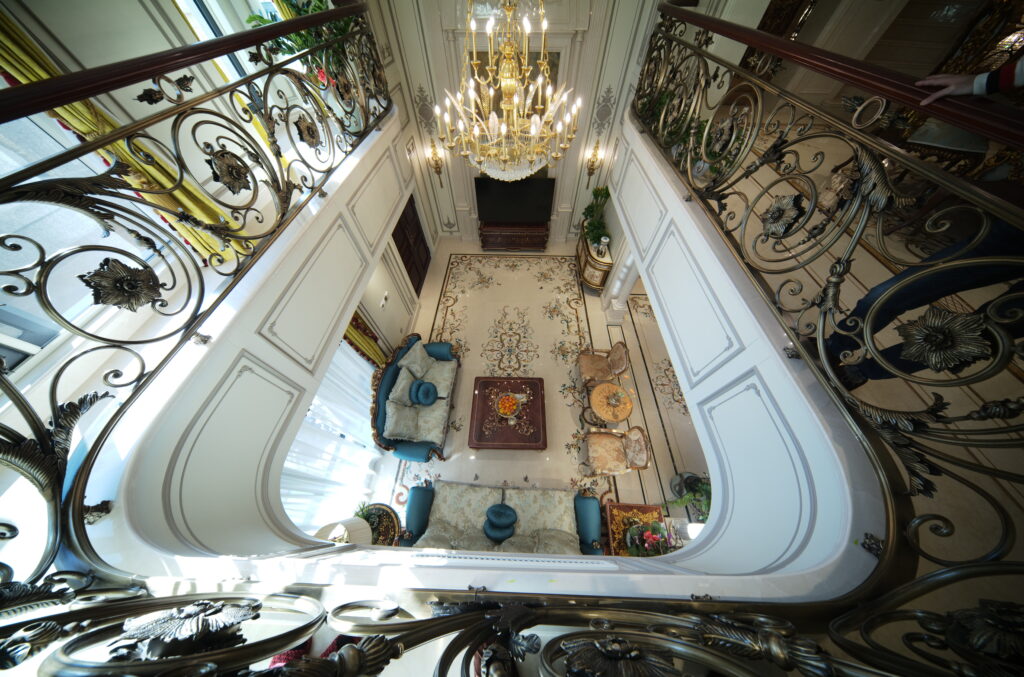
Custom Marble Inlay Flooring: Architectural Specification (Executive Summary)
Custom marble inlay flooring is an architectural stone surface created by cutting contrasting varieties of natural marble, limestone, onyx, and semi-precious minerals into intricate interlocking components using 5-axis abrasive waterjet machinery (±0.1 mm tolerance), dry-assembling the modules over fiberglass or aluminum mesh in the atelier, and installing them onto a reinforced subfloor with zero-grout, color-matched polyester or epoxy resin joints polished flush on-site to produce a seamless, monolithic floor.
Technical Review: Bruce (Senior Technical Director) · Subfloor Standard: Deflection ≤ L/720 · Waterjet Tolerance: ±0.1mm · Lead Time: 4–8 weeks.
Custom marble inlay flooring represents the pinnacle of natural stone craftsmanship in luxury architecture. Whether framing the grand entrance foyer of a private estate in Beverly Hills, anchoring a 500-square-meter royal majlis in the Gulf, or gracing a five-star hotel lobby in London, precision-cut stone inlay transforms bare spatial volume into a permanent, monolithic work of art.
Start here — Art Inlay Technical Resource
This guide is part of our technical library for architects, interior designers, and general contractors. For our full catalog of waterjet works, explore our Custom Marble Inlay Collection, read our guide to Marble Medallion Sizes & Placement, review Adding a Marble Border to a Floor, or download our Architectural Specification TDS.
However, specifying custom marble inlay requires a far higher level of engineering discipline than standard tile or slab flooring. Without strict attention to stone hardness matching, CNC waterjet cutting tolerances, substrate deflection ratios, and resin-fill chemistry, even the finest Italian Statuario or Spanish Nero Marquina will suffer from lippage, shear cracking, or differential wear over time.
1. Custom Marble Inlay Cost Matrix: Architectural Budgeting (2026–2027)
One of the most persistent hurdles during schematic design is budgetary forecasting. Because traditional stone importers and middlemen markup custom inlay work by 200% to 400%, architects often receive wildly disparate quotes. At our atelier in Jiangmen, custom marble inlay pricing is governed by four objective parameters:
- Geometric Complexity (Cutting Line Density): The total linear meters of abrasive waterjet cutting required per square meter of floor.
- Stone Material Grades: Yield loss varies significantly between sound, uniform stones (Bianco Carrara) and brittle, heavily veined stones (Portoro, Calacatta Viola).
- Module Thickness & Backing Structure: Standard solid 18mm–20mm stone versus ultra-thin 5mm stone backed on aerospace-grade aluminum honeycomb for elevators and suspended spans.
- Pre-assembly Scope: Whether modules are delivered face-taped with keyed numbering or supplied as bonded interlocking tiles.
| Complexity Tier | Typical Design Patterns | Stone Varieties Included | Price per Sq Ft (Factory Direct) | Price per Sq Meter (Factory Direct) | Lead Time (50–200 m²) |
|---|---|---|---|---|---|
| Tier 1: Geometric & Linear | Chevrons, octagons with contrast cabochons, interlocking squares, wide Greek keys | Bianco Carrara, Crema Marfil, Nero Marquina, Dark Emperador | $26 – $45 / sq ft | $280 – $480 / m² | 3 – 4 weeks |
| Tier 2: Neoclassical & Botanical | Rinceau scrolls, acanthus leaves, guilloche borders, rococo medallions | Statuario, Calacatta Gold, Verde Alpi, Rosa Portogallo, Giallo Siena | $48 – $85 / sq ft | $520 – $920 / m² | 4 – 6 weeks |
| Tier 3: Arabesque & Majlis | 8-point and 12-point Islamic star geometries, intricate calligraphy, fine tessellation | Thassos Pure White, Belgian Black, Persian Blue onyx, honey onyx | $85 – $140 / sq ft | $920 – $1,500 / m² | 6 – 8 weeks |
| Tier 4: Palatial Pietre Dure | Pictorial panels, micro-inlay botanical shading, semi-precious stone accents | Lapis lazuli, malachite, tiger’s eye, mother-of-pearl, brass filigree | $140 – $280+ / sq ft | $1,500 – $3,000+ / m² | 8 – 12 weeks |
Note: Figures reflect factory-direct fabrication, dry-assembly, numbered crating, and ocean freight packaging. They exclude local import duties, site adhesive compounds, and local setting-out/polishing labor.
2. Core Design Patterns: From Classical Heritage to Contemporary Luxury
The design vocabulary of marble inlay spans over two millennia, evolving from Roman opus sectile and Renaissance Florentine commesso in pietre dure to Mughal architectural inlay. Modern CNC abrasive waterjet technology allows architects to execute these historical languages with microscopic accuracy or invent entirely new contemporary geometries.
A. The Grand Foyer Inlay: Central Medallion + Field Integration
In luxury residential projects, the entryway foyer establishes the design standard for the entire residence. Performance data from architectural projects indicates that architects and luxury homeowners frequently search for foyer marble inlay solutions. The most successful foyer layouts utilize a tripartite composition:
- The Central Focus: A circular or elliptical waterjet medallion placed on the vertical axis of the primary entry chandelier.
- The Neutral Field Margin: A 600mm to 1,200mm neutral perimeter margin (e.g., honed Bianco Carrara or Botticino) that gives the eye breathing space and absorbs uneven wall geometries.
- The Encircling Border: A 150mm–300mm running border (such as a Greek key, running wave, or Vitruvian scroll) that frames room thresholds and ties adjacent circulation corridors together.
B. Continuous Field Patterns (Allover Inlay)
In dining salons, ballrooms, and hotel lobbies, single medallions may feel fragmented. Continuous repeating inlay—such as interlocking marble ribbons, hexagonal basketweaves with contrasting cabochons, or four-way bookmatched star modules—unifies vast floor areas into a coherent architectural floor.
C. Stone and Metal Hybrid Inlay
One of the fastest-growing specifications in high-end hospitality and penthouse projects is the integration of cold-rolled architectural brass or stainless steel inlays within natural stone. Art Inlay cuts brass flat bars (3mm to 6mm width) on the same CNC waterjet platform as the surrounding marble. The brass is anchored with specialized epoxy beds to account for differential thermal expansion coefficients between copper alloys and metamorphic stone.
3. Material Science: Stone Selection & Hardness Compatibility
The most common failure in amateur marble inlay design is combining stones with incompatible physical properties. Marble is a geological material; its hardness, porosity, and compressive strength vary dramatically across varieties.
The Differential Wear Trap
Never specify a soft calcite marble (e.g., Nero Marquina, Mohs 3) directly adjacent to a hard granite or quartzite (Mohs 6.5–7) in a high-traffic corridor unless the floor is maintained with dry crystallized polishing. Under foot traffic, the softer stone wears faster, causing the harder stone edges to protrude, creating micro-ridges and optical shadows.
| Aesthetic Mood | Background Field Stone | Inlay Accent Stone 1 | Inlay Accent Stone 2 | Mineral Compatibility |
|---|---|---|---|---|
| Timeless Neoclassical | Calacatta Gold / Statuario (Italy) | Nero Marquina (Spain) | Giallo Siena / Honey Onyx | Excellent (Mohs 3.0–3.5 across all components) |
| Monochrome Minimalist | Thassos Extra White (Greece) | Belgian Black / Nero Assoluto | Bardiglio Nuvolato (Italy) | Very Good (Uniform density, low porosity) |
| Mediterranean Warmth | Crema Marfil (Spain) | Dark Emperador (Spain) | Rojo Alicante (Spain) | Excellent (Identical dolomitic limestone matrix) |
| Royal Majlis & Gulf Splendor | Royal Botticino (Italy) | Verde Alpi (Italy) | Lapis Lazuli & Brass Filigree | Engineered (Requires flexibilized epoxy bedding) |
4. Fabrication Engineering: From CAD Vectors to ±0.1mm Waterjet Precision
At Art Inlay, transforming an architect’s concept sketch into a precision floor involves four strict manufacturing stages:
- Vector Clean-up & Taper Correction: Abrasive waterjets use a high-pressure garnet stream (up to 60,000 PSI). Without dynamic 5-axis head compensation, the waterjet stream naturally tapers as it cuts through 18mm–20mm stone, causing the bottom of the cut to be narrower than the top. Our atelier utilizes 5-axis dynamic tilting cutting heads that lean into the cut angle, producing a perfectly perpendicular 90-degree cut face across the entire thickness of the slab.
- Hand Selection & Directional Grain Matching: Master stone artisans examine each raw slab for natural fissures, crystalline pockets, and directional veining. In classical medallions and border runs, veining must radiate symmetrically outward from the center point, creating harmonious floral bursts rather than random, mismatched directional streaks.
- Dry-Assembly Verification in the Atelier: Before any shipment leaves our facility, the entire floor—whether a 2-meter foyer medallion or a 300-square-meter ballroom composition—is completely dry-assembled on our inspection floor. High-resolution overhead orthophotos are captured and sent to the specifying architect for formal sign-off.
- Interlocking Crating & Numbering: Each section is marked with durable, numbered alphanumeric coordinates matching the project CAD layout drawing and packed into foam-lined seaworthy timber crates.
5. Architectural Subfloor Engineering & Zero-Grout Installation Standards
A luxury marble inlay floor is only as stable as the concrete beneath it. Specifiers must include these structural parameters within their Section 09 30 00 (Tiling) and Section 09 38 00 (Custom Stone) specifications:
A. Deflection Criteria (L/720 Standard)
Standard ceramic tile requires a substrate deflection limit of L/360. In contrast, custom marble inlay requires a minimum deflection rating of L/720 under total load (or L/1080 for large-format slabs). Any substrate bounce will shear the delicate resin seams connecting contrasting stone pieces.
B. Moisture Vapor & Uncoupling Membranes
Concrete subfloors must have a relative humidity (RH) below 75% per ASTM F2170. Always specify an uncoupling crack-isolation membrane (such as Schluter-DITRA or equivalent ANSI A118.12 membrane) between the screed and the stone mortar bed. This neutralizes lateral substrate movement and prevents building settlement cracks from transferring through the inlay.
C. Mortar Formulation
Utilize a polymer-modified, medium-bed white thin-set mortar conforming to ANSI A118.4 or ANSI A118.15 (e.g., Laticrete 254 Platinum White or Mapei Kerabond/Keralastic). Gray mortars must never be used beneath white or translucent marbles (Statuario, Thassos, Onyx), as chemical bleed will permanently discolor the stone face.
D. Zero-Grout Seam Polishing Protocol
Unlike standard tile installations that feature 2mm–3mm cementitious grout joints, custom marble inlay is designed as a continuous, seamless surface:
- Pieces are butted tight during dry-setting with hair-thin joints (under 0.5mm).
- Seams are evacuated of dust and vacuumed clean.
- Joints are filled with knife-grade transparent polyester or epoxy resin tinted on-site with dry mineral pigments to match the exact background color of each specific stone piece.
- Once cured, the entire floor is diamond-ground with progressive resin-bond abrasives (from 50-grit up to 3000-grit) and crystallized.
- The resulting surface is completely flat to the touch—running a hand across borders and medallion seams reveals zero lippage, zero grout indentations, and 100% monolithic reflection.
6. Frequently Asked Questions (FAQ)
How much does custom marble inlay flooring cost per square foot?
Custom marble inlay flooring costs between $26 and $85 per square foot ($280 to $920 per square meter) factory-direct for classical geometric, border, and neoclassical medallion designs. Highly intricate botanical patterns, Arabesque majlis compositions, or palatial pietre dure incorporating semi-precious stones (lapis lazuli, malachite, mother-of-pearl) range from $140 to $280+ per square foot ($1,500 to $3,000+ per square meter).
Can custom marble inlay flooring be installed over underfloor radiant heating?
Yes. Custom marble inlay performs exceptionally well over hydronic and electric in-floor radiant heating systems due to the natural thermal mass and conductivity of marble. However, the system must utilize an uncoupling membrane (such as Schluter-DITRA-HEAT), a high-polymer flexible thin-set mortar (ANSI A118.15), and must be slowly brought to operating temperature (maximum 1°C per 24 hours) after the stone adhesives have fully cured for 28 days.
What is the difference between waterjet marble inlay and traditional handmade stone inlay?
Traditional handmade stone inlay (such as historical Agra pietre dura) relies on artisans carving recesses into base marble using handheld chisels and grinding individual inlay stones to fit. While historically significant, it is prone to joint inconsistencies (0.8mm–2.0mm) and high labor costs. Modern 5-axis abrasive waterjet inlay cuts both the receiving field matrix and the inserting stone from digital CAD vectors at tolerances of ±0.1mm. This guarantees hairline joint tolerances, identical repeating motifs across multi-room estates, and seamless zero-grout monolithic polishing.
What thickness is recommended for custom marble inlay floors?
The international architectural standard for solid marble inlay flooring is 18mm to 20mm (3/4 inch). For yacht interiors, executive private aircraft, and luxury elevator cabs where structural weight is strictly limited, Art Inlay fabricates lightweight composite inlay panels featuring a 5mm natural stone veneer laminated to an aerospace aluminum honeycomb backing, reducing weight by over 70% while maintaining identical tensile strength and surface beauty.
How do you clean and maintain a polished marble inlay floor?
Custom marble inlay floors should be cleaned exclusively with pH-neutral stone cleaners (pH 7.0–8.0) and microfiber flat mops. Acidic cleaners (vinegar, lemon-based formulas), bleach, and harsh de-greasers must be strictly avoided as they etch calcite marbles and dissolve polyester joint fillers. Upon initial installation, the floor should be impregnated with a breathable oleophobic penetrating sealer, with high-traffic commercial vestibules receiving periodic maintenance re-crystallization every 12 to 24 months.
7. Specifying Your Commission: The Art Inlay Process
Whether you are designing a private residential estate in Beverly Hills, a luxury retail flagship on Fifth Avenue, or a palatial residence in Riyadh, Art Inlay collaborates directly with architects and design studios worldwide:
- Schematic CAD Consultation: Submit your 2D floor plans, mood boards, or sketches to our technical team in DWG or PDF format.
- Material Sampling & Render Generation: Receive tailored digital renderings, stone palette proposals, and physical polished material samples.
- Shop Drawings & Fabrication: Full vector engineering with kerf compensation, 5-axis waterjet cutting, and full atelier dry-assembly.
- Worldwide Turnkey Delivery: Crating with numbered assembly maps and technical installation guidance delivered directly to your project site.
Ready to specify your project?
Contact our master artisan team at [email protected] or submit your project details via our Bespoke Inlay Project Inquiry.