
Marble inlay is the art of setting cut pieces of coloured stone into a stone surface so they close into a single, seamless picture or pattern, a floor, a medallion, a wall panel or a border. Done well, the joints disappear and the design reads as one piece of stone. This guide explains what marble inlay is, how it is made, the main types, where it is used, and how to specify it so the finished floor fits first time.
Start here. This is the hub for our marble inlay resources. For the specifics, see inlaid marble flooring, marble medallions, pietre dure and borders; what drives cost; inlay vs tile; and the architectural specification guide.
What is marble inlay?
Marble inlay (also written marble inlays in the plural, or stone inlay) is a decorative technique in which pieces of marble, onyx, semi-precious stone or metal are cut to shape and fitted into a base surface to form a pattern or image. Unlike paint or applied veneer, the design is the floor itself: each colour is a different stone, and the pattern is held by precisely cut joints rather than by grout.
The defining characteristic is the joint. Traditional tiling leaves a visible grout line; true inlay is cut to a tolerance, at Art Inlay, ±0.1mm, and lapped and sealed as one surface so the pattern never lifts, drifts or shows a line. That is what separates marble inlay from a printed tile or a mosaic sheet.
A short history of marble inlay
Inlay is one of the oldest forms of architectural decoration. Roman and Byzantine floors used opus sectile, cut stone shapes set into a ground. In medieval Italy the Cosmati workshops built geometric inlaid floors into churches, and in Florence the pietre dure (hardstone) tradition turned inlay into painting with stone, using lapis, jasper and agate. In Mughal India, the same idea reached its peak in the parchin kari floral inlays of the Taj Mahal. Today the technique combines that craft with modern CAD and waterjet cutting, which is what makes large, complex and perfectly closing patterns possible at architectural scale.
The main types of marble inlay
Marble inlay flooring
Full-room floor patterns, geometric, floral or bespoke, cut and set into the substrate with no grout lines. The floor is planned as a system: borders are calculated from the room’s axes, field panels are sized to the stone that actually exists, and underfloor heating, movement joints and substrate tolerances are engineered into the cut plan. See marble inlay flooring.
Marble medallions
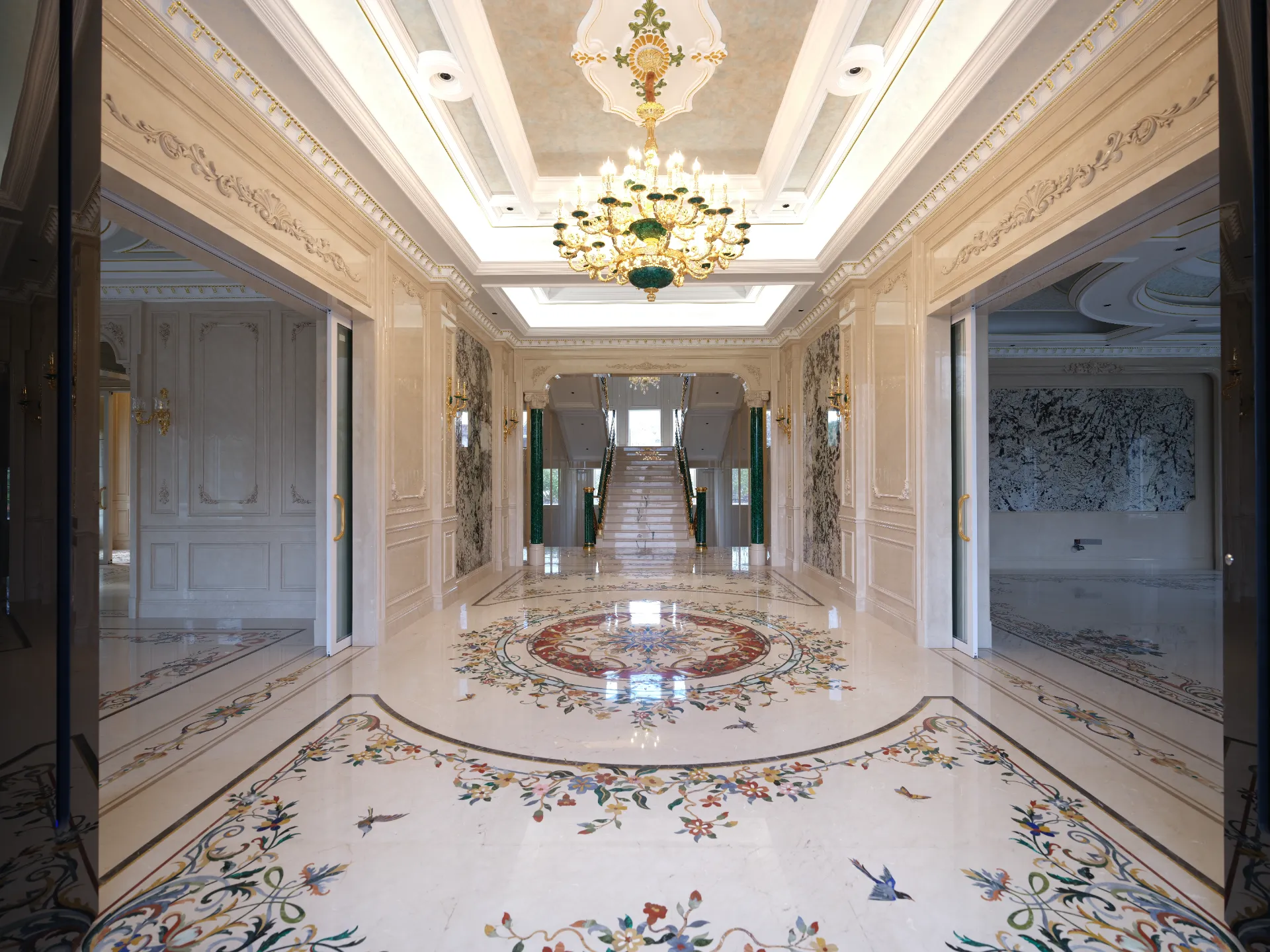
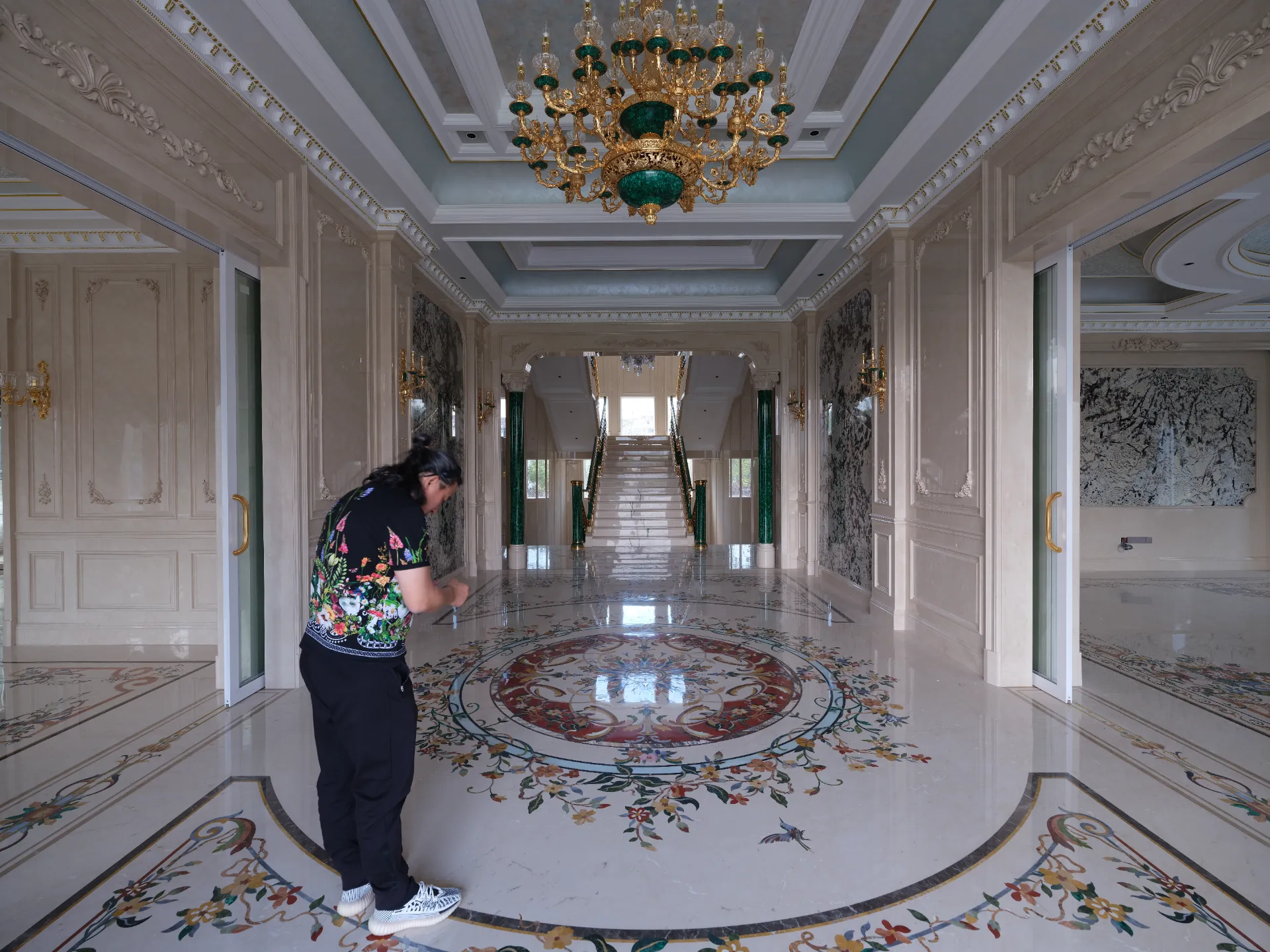
A medallion is a waterjet-cut centrepiece for a floor, the focal point of a foyer, lobby or stair hall. We make marble floor medallions from 800mm to over 6 metres, plotted from a single centre so the pattern closes perfectly, and split into numbered segments with joints hidden along pattern lines. See marble medallions.
Pietre dure
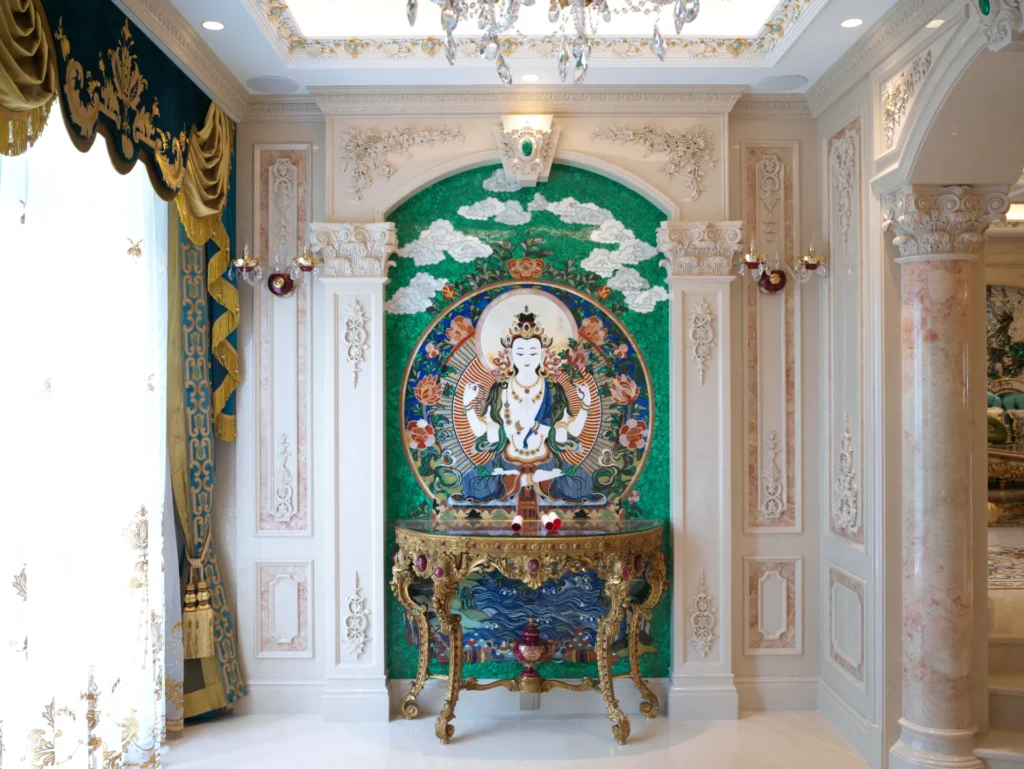
Pietre dure, “stone painting”, builds a pictorial image from hundreds or thousands of hand-fitted pieces of hardstone such as lapis lazuli, malachite and jasper, closed to a 0.8mm joint. This is the rarest form of inlay, used for wall panels, crests, birds and florals. See pietre dure.
Borders and accents
Borders frame a floor, mark the edge of a medallion and absorb the tolerances where stone meets wall or timber. Cut from a single waterjet file, a repeated motif such as a Greek key or guilloche turns a corner without a break. See borders & accents.
Inlaid art and inlay architecture
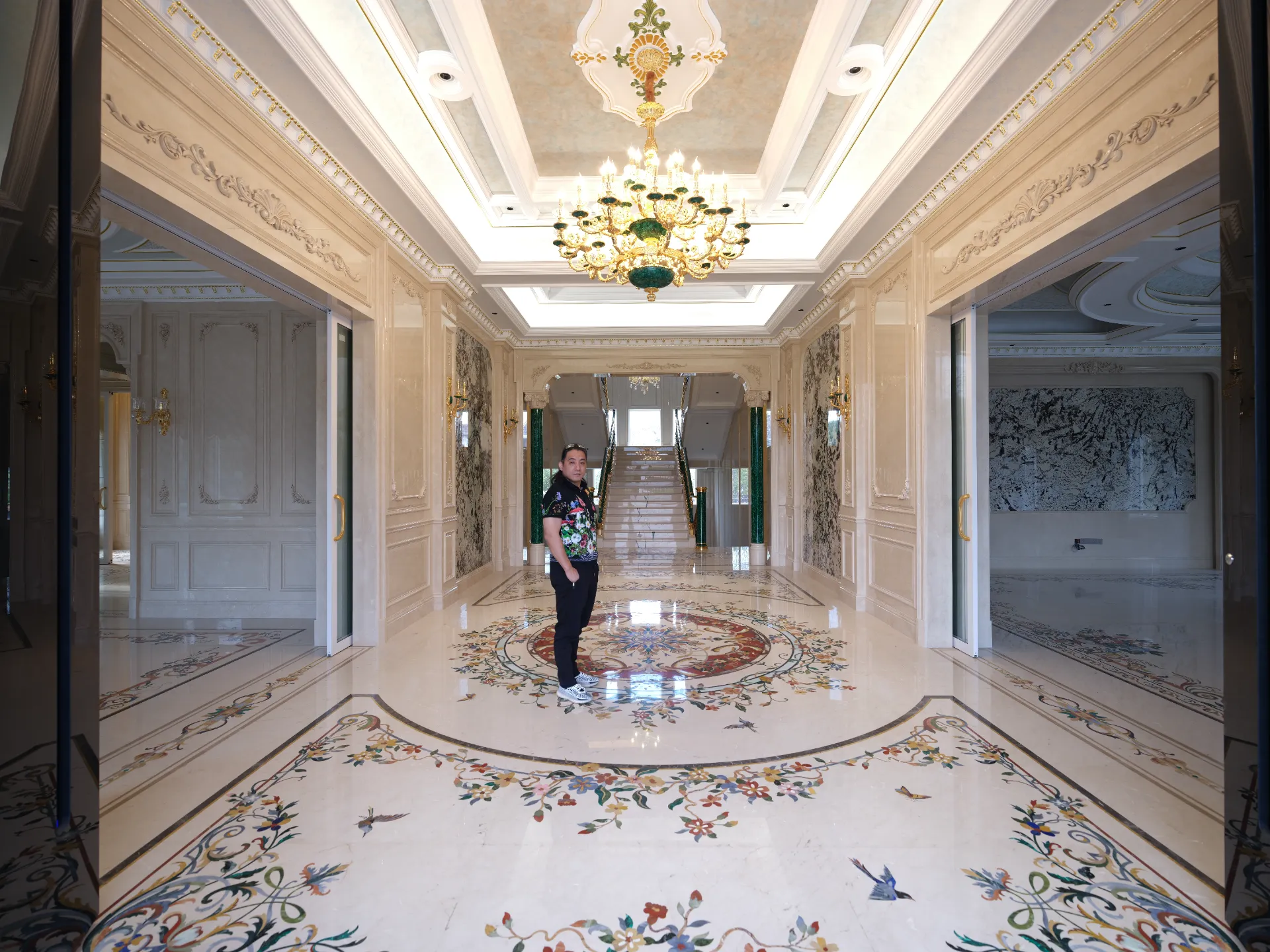
Beyond floors, inlaid art and inlay architecture cover the use of stone inlay as a design language for a whole interior: wall panels and feature walls, framed cartouches, headboards, stair risers, vanity tops and flooring that reads as a single composition from the entrance through to the principal rooms. In high-end architecture, inlay is used to tie a room to its axis, the medallion beneath the chandelier, the border that follows the walls, the stair whose runner continues the floor pattern.
Because the pattern is drawn to the architecture rather than applied to it, inlay is specified early, with the architect, and cut to the site’s real dimensions. That is the difference between inlaid art and decoration.
Materials used in marble inlay
Marble inlay can use any cuttable stone, and the palette is chosen against the drawing, vein by vein. Common marbles include Calacatta, Statuario, Crema Marfil, Nero Marquina, Verde Alpi, Rosso Levanto and Emperador. For pietre dure we use semi-precious hardstones, lapis lazuli, malachite, jasper, agate, onyx and mother-of-pearl. Fine lines and logos can be inlaid in brass or stainless fillets. Dense, hard stones are reserved for high-traffic areas.
How marble inlay is made
Every Art Inlay commission follows the same disciplined process, all under one roof in our Jiangmen factory:
- The cartoon. The design is drawn full size, 1:1, before any stone is cut, so proportions and veining are approved at the scale you will walk on.
- Stone selection. Blocks and slabs are chosen against the drawing, vein by vein, and photographed for approval.
- Waterjet cutting. Multi-axis waterjets cut every piece directly from the approved CAD file, held to ±0.1mm across the whole figure.
- Hand-closing the joint. Machines get us to a tenth of a millimetre; the last fraction is craft, closing each piece against its neighbour until the joint melts into the drawing.
- Dry assembly and crating. The full composition is assembled, inspected, numbered and photographed on the factory floor, then crated with a setting plan.
You sign off the drawing before we cut, and the finished stone before we ship. See how we make it.
Marble inlay vs marble tile
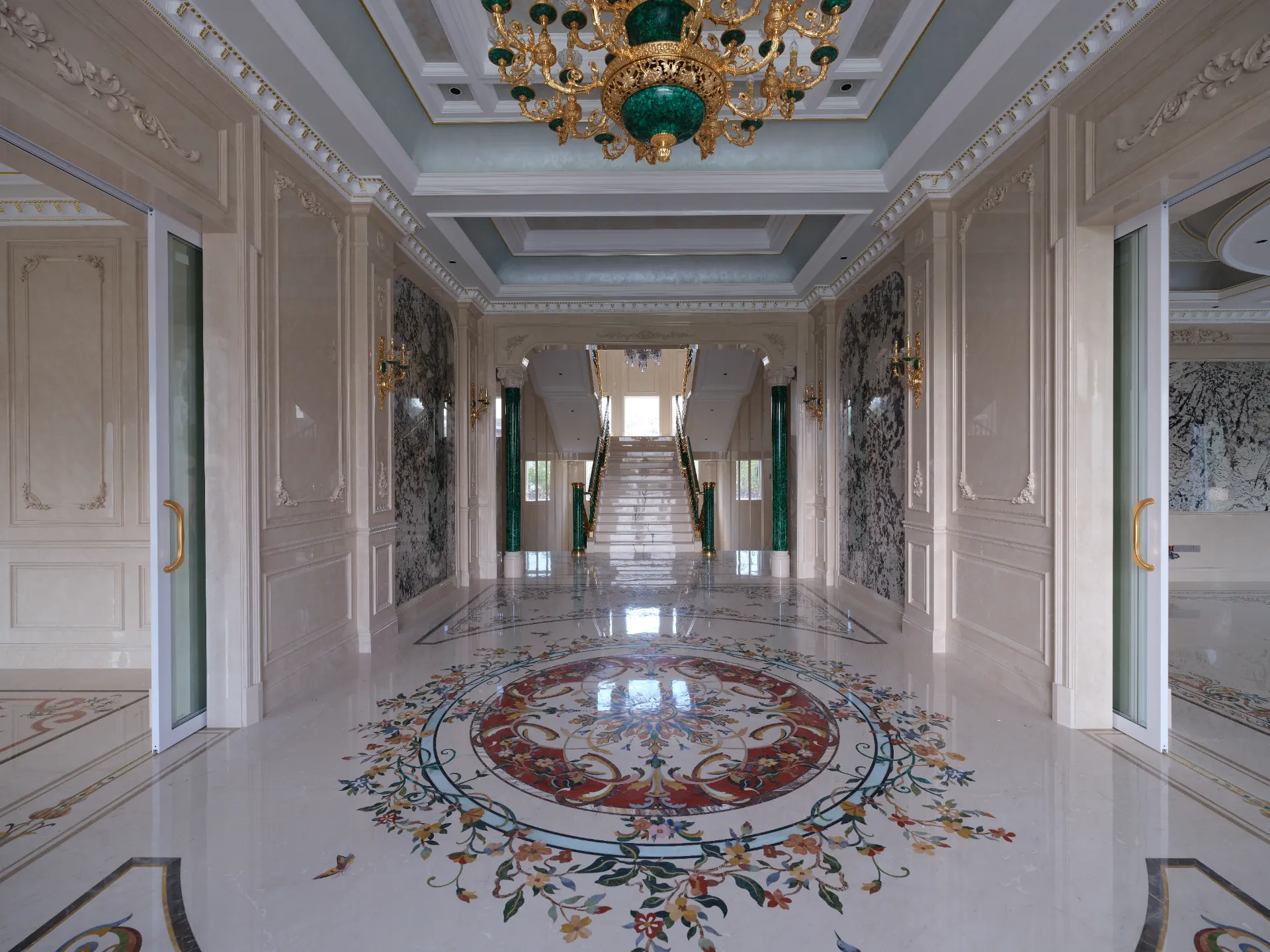
Marble inlay and marble tile both use natural stone, but inlay is a single engineered composition cut to the room with no grout lines, while tile is a repeatable, grouted module. For the full comparison, joints, pattern, cost, speed and performance, read marble inlay vs marble tile.
Where marble inlay is used
Inlay is most often specified for the parts of a building that must make an impression and take heavy use:
- Entrances, foyers and lobbies, arrival floors set out from the door axis and engineered for traffic. See entrances, foyers & lobbies.
- Bathrooms and spas, slip-resistant, sealed and drained within the pattern. See bathroom & spa inlay.
- Stair halls and galleries, runners and landings that continue the floor pattern.
- Feature walls and reception rooms, pietre dure panels and inlaid cartouches.
Design considerations
Three things decide whether an inlaid floor looks effortless or awkward: scale (the pattern must be sized to the room, not to a sample), contrast (colour and figure must read from standing height, not from a render), and engineering (substrate tolerance, movement joints, underfloor heating and drainage planned into the cut file). Get these right at the drawing stage and the installation is fast and calm; get them wrong and no amount of skill at the bench will hide it.
What does marble inlay cost?
There is no price per square metre for marble inlay, because every floor is cut to a drawing. The number is driven by pattern density, stone, complexity and area. For the full breakdown, and how to compare quotes honestly, see what drives the cost of marble inlay.
Caring for marble inlay
A correctly sealed, lapped inlay floor is no harder to maintain than any other polished marble: pH-neutral cleaner, dry dusting, and periodic re-polishing of traffic lanes. Since the pattern is set into the substrate with hairline joints, there is no grout to scrub and no edge to catch. See the maintenance & restoration guide.
Why buy marble inlay factory-direct?
Art Inlay has made bespoke stone inlay in our own factory since 2008, delivering to more than 40 countries. Drawing, waterjet cutting, hand-fitting and dry assembly happen under one roof, which means the tolerances hold, the material study matches the finished stone, and there is no middleman between the drawing and the floor. You deal with the makers.
Marble inlay patterns and motifs
Most inlaid floors draw on a small family of motifs, scaled and combined to suit the room. Geometric patterns, squares, octagons, stars and radiating figures, give structure and suit long halls and corridors. Floral and foliate designs, from a single sprig to a full bouquet, soften formal rooms. Greek key and guilloche borders frame a field and turn corners without a break. Arabesque and acanthus scroll motifs bring movement. Cartouches and crests are placed as focal points. The craft is less about inventing a motif than about scaling it correctly and holding the joint so the pattern stays crisp across a whole floor, which is why every pattern is drawn full size before it is cut.
Semi-precious stone inlay
For the most rarefied commissions, inlay moves beyond marble into semi-precious stone. Lapis lazuli supplies a deep ultramarine, malachite a banded green, jasper a warm brown, and agate, onyx and mother-of-pearl add translucency and shimmer. Used in pietre dure panels, these stones let a picture, a bird, a bloom, a coat of arms, a landscape, be built from thousands of hand-fitted pieces. Because hardstones are cut thin and fitted by hand, semi-precious inlay is the slowest and most exclusive form of the craft, and it is normally reserved for wall panels, feature floors and objects where the eye comes close. See pietre dure & semi-precious stone inlay.
How to specify marble inlay: a checklist for architects
Specifying inlay early is the difference between a calm installation and an expensive surprise. A complete specification usually includes:
- Setting-out drawing, the floor plan with the inlay’s axis, borders and field sizes marked, so the pattern aligns with walls, doors and stairs.
- Stone schedule, the exact marbles (and semi-precious stones) for each colour in the pattern, with finish.
- Thickness and substrate, typically 18mm structural stone (20mm for heavy traffic), with the substrate tolerance and any decoupling defined.
- Finishes, polished, honed, brushed or leathered, and where each applies (for example, honed traffic lanes, polished feature field).
- Underfloor heating and movement joints, planned into the cut file, with joints hidden along pattern lines.
- Wet-zone requirements, slip rating, sealing and drainage falls for bathrooms, hammams and spas.
- Approvals, sign-off on the full-size drawing and on the dry-assembled floor before shipping.
- Delivery, numbered panels, a setting plan and crating for export.
A maker who asks for the drawing, not a sample board, and returns a cut plan and material study is the sign of a factory that engineers inlay, rather than reselling it. See the architect’s guide to marble inlay flooring.
For the full checklist, setting-out, stone schedule, thickness, finishes, underfloor heating, movement joints, wet zones and approvals, download our free marble inlay specification guide.
Marble inlay around the world
Inlay has never been one tradition. Italy gave the world the Cosmati floors and the Florentine pietre dure workshops; India gave it the parchin kari floral inlays of the Taj Mahal; the Islamic world developed intricate geometric zellij and marble jali. Today the same principles are applied in private villas, palaces and five-star hotels, floors in Dubai, London, New York and Riyadh are cut and dry-assembled in factories like ours, then shipped and laid thousands of kilometres away. What has changed is the tooling: CAD and waterjet cutting now hold tolerances of ±0.1mm across figures several metres wide, which is what makes contemporary inlaid art possible.
Frequently asked questions
What is marble inlay made of?
Natural marble and other cuttable stones, Calacatta, Nero Marquina, Verde Alpi and more, plus semi-precious stones such as lapis, malachite and jasper for pictorial work, and brass or stainless fillets for fine lines.
Is marble inlay the same as mosaic?
No. Mosaic sets small, roughly uniform pieces with visible grout. Inlay cuts larger, precise pieces to a CAD file and closes the joints to a hairline so the design reads as one surface.
How is the pattern cut so precisely?
Every piece is cut on a multi-axis waterjet directly from the approved CAD file, then hand-closed at the bench, held to ±0.1mm.
Can marble inlay be used with underfloor heating?
Yes, movement and thermal expansion are engineered into the cut plan, with flexible adhesives and decoupling specified where required.
How long does a custom marble inlay project take?
Typically 6–10 weeks from an approved drawing (longer for dense pietre dure), plus shipping.
Do you work from our architect’s drawing?
Yes. Send a CAD file, sketch or photograph; we return a cut plan and material study for approval before any stone is cut.
Can you match an existing marble inlay floor?
Often, yes, photograph the floor straight-on with a reference measurement and we will reverse-engineer the pattern.
Where do you ship?
Worldwide, recent floors and medallions are installed across the Middle East, Europe, Asia, Africa and North America.
Commissions
Start a marble inlay project
Send a drawing or a photograph, we return a technical material study, a cut plan and an itemised quote within three working days.