
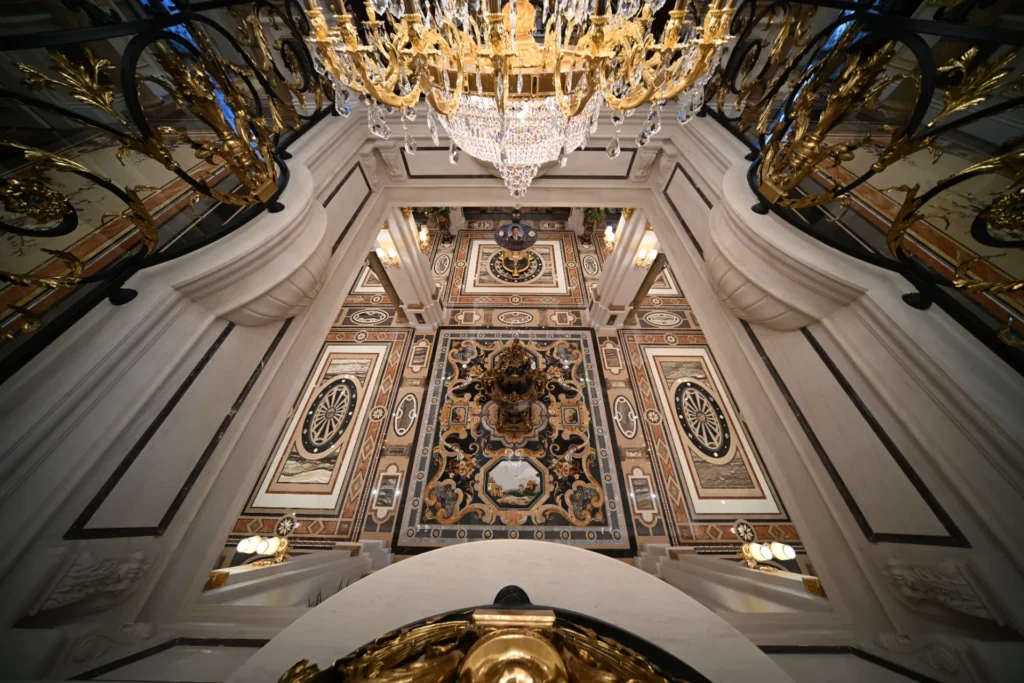
Geometric marble inlay is inlay built from regular figures, squares, hexagons, stars, circles, chevrons and interlacing lines, rather than from pictures. It is the oldest and most architectural form of stone inlay: it sets the floor’s rhythm, survives changes of taste, and reads cleanly from across a room. This guide covers the main pattern families, where each belongs, and how geometry differs from pictorial inlay.
Start here. Part of our inlay library: see inlaid marble flooring, marble medallions and the borders guide.

What counts as geometric inlay
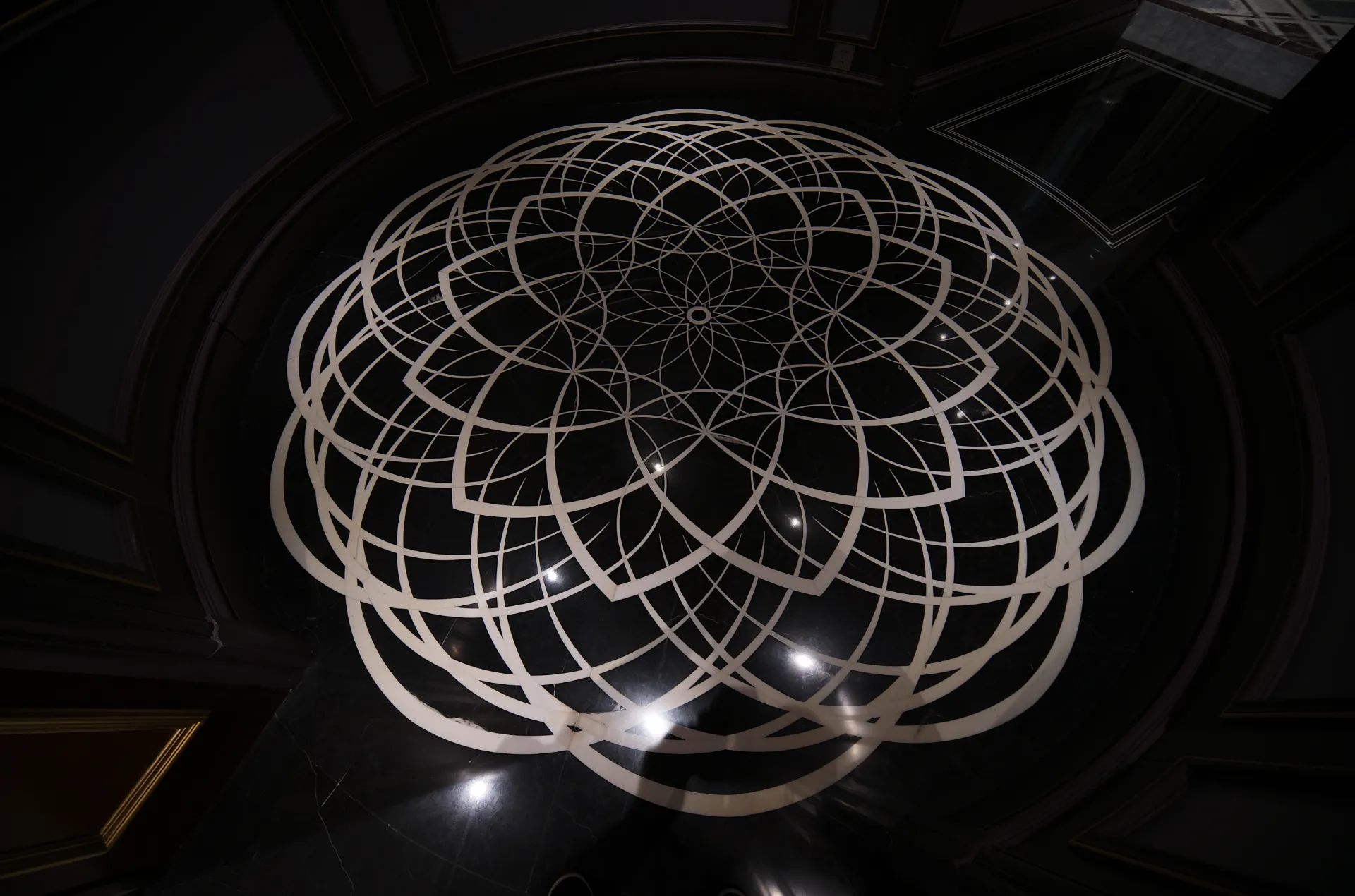
If a pattern can be drawn with a rule and a pair of compasses and repeats, it is geometric. Think of the floor of a Florentine chapel, a Moroccan zellij, an Art Deco lobby or a modern marble rug, all are built from the same small set of moves: a grid, a repeat, and a motif that turns cleanly at every junction. Because the shapes are regular, the joints can be planned exactly, which is why geometry and precision cutting belong together.
The main pattern families
Squares, grids and the checker
The simplest and most robust: a grid of squares in two or more stones, set on the diagonal or square to the walls. A diagonal grid (diamond) makes a room feel broader; a square grid feels calmer and more formal.
Octagons, hexagons and honeycomb
Octagon-and-square or hexagonal layouts cover a floor with no gaps and no cut pieces at the junctions. They suit large halls and are efficient to cut, a favourite for lobbies and entrance floors.
Stars and interlace
Eight-point stars, six-point stars and interlacing ribbons (girih, guilloche) bring movement. They are denser and read best in larger rooms or as a band rather than a whole floor.
Chevron, herringbone and the running line
Linear geometry gives direction. Chevron and herringbone imply movement and work well in circulation spaces; a single running line or an interlocking key frames a field.
Pietra dura geometry
The semi-precious tradition uses the same geometry, inlaid stars and panels, but with colour and material doing the work. See pietre dure.
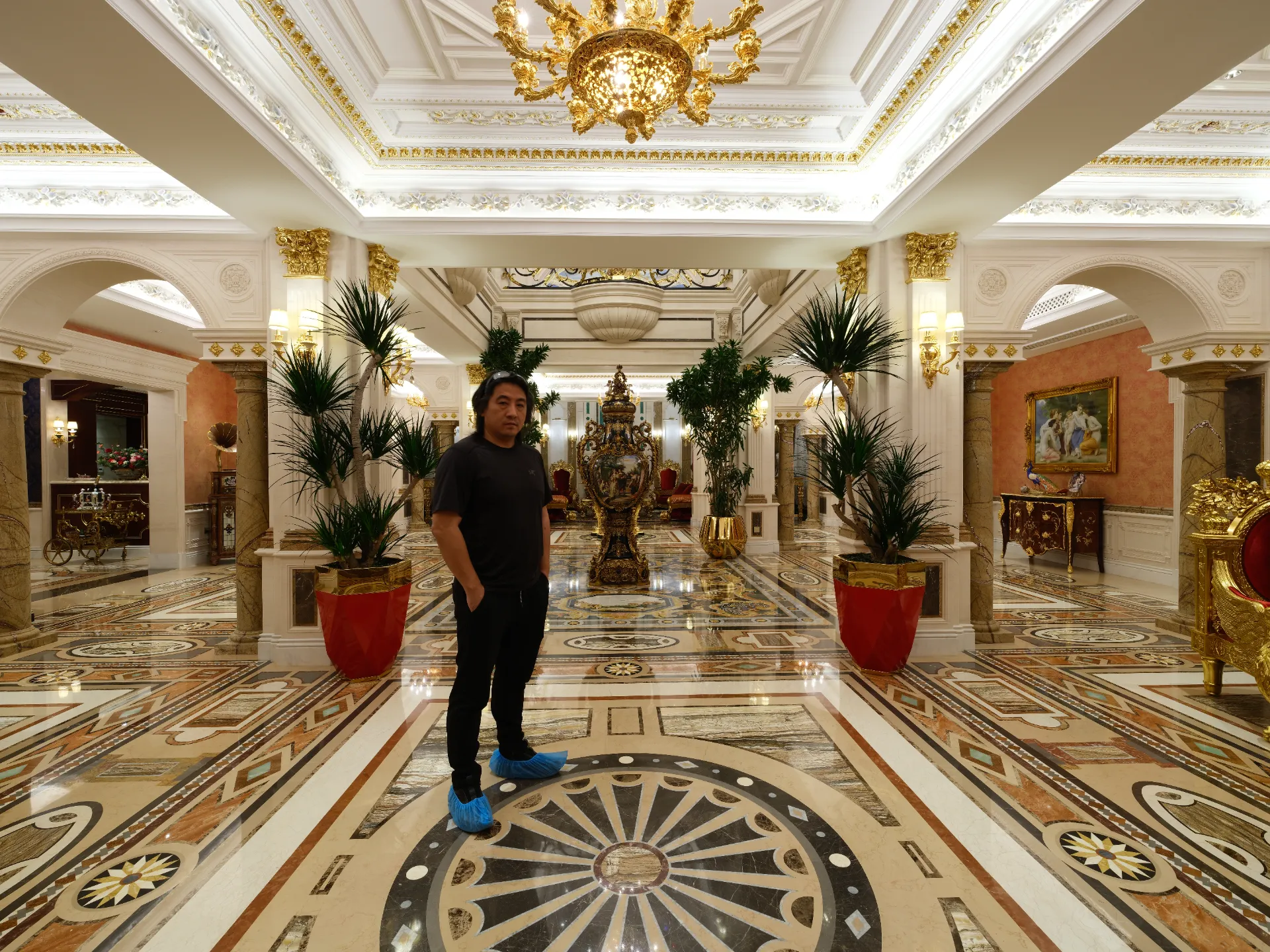
Geometry or picture? The two families of inlay
Inlay falls into two broad families. Geometric inlay repeats a figure, a floor pattern, a border, a grid. Pictorial inlay (pietre dure) builds a single image from many stones. A project often uses both: a geometric field with a pictorial medallion at the centre. When in doubt, keep the field geometric and let one figure carry the picture.
Where geometric inlay belongs
- Entrance halls and lobbies, an octagon or diamond grid gives a floor scale and formality.
- Circulation and corridors, chevron or a running border manages a long view.
- Bathrooms and spas, small repeats and bands feel precise and calm.
- Feature floors, a bold star or interlace becomes the room’s anchor.
- Contemporary interiors, a two-stone grid (Calacatta and Nero Marquina) is quiet, graphic and timeless.
How geometry is cut and set
Geometry rewards planning: because every piece is regular, the whole pattern is engineered in CAD first, with the repeat, the cuts and the setting-out fixed before a slab is opened. The pieces are waterjet-cut to ±0.1 mm, dry-assembled on the factory floor, photographed for approval and shipped numbered with a setting plan, so the pattern lands true to the drawing. See waterjet marble cutting.
Frequently asked questions
Is geometric inlay cheaper than pictorial?
Usually, fewer, more regular pieces mean less cutting and assembly than a detailed picture of the same area.
Can I use three or more stones?
Yes; keep one dominant field stone and use the others for the lines so the pattern stays legible.
Will the pattern align with the room?
The set-out is drawn to the room, not to a default module, so the grid meets the walls and openings where the design intends.
Does geometry work with underfloor heating?
Yes, movement is engineered into the layout and the joints are closed with stone epoxy.
In historic and contemporary London properties, neoclassical and Georgian geometric stone floors set out from the room’s sightlines create timeless architectural continuity — see our casework for marble inlay in London.
Commissions
Start a geometric inlay project
Send a drawing or a photograph, we return a technical material study, a cut plan and an itemised quote within three working days.