
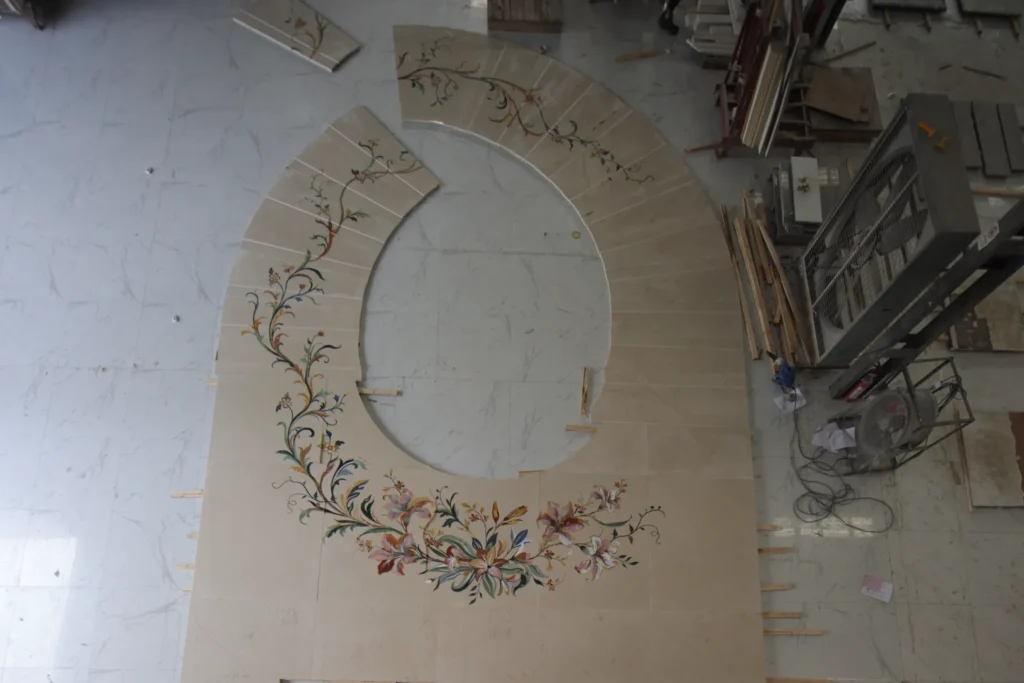
Pietre dure, Italian for “hard stones”, is the art of building a picture from cut pieces of semi-precious stone. Where mosaic uses small, uniform tiles, pietre dure uses larger, individually shaped pieces of lapis lazuli, malachite, jasper, agate and marble, fitted together so closely that the image reads as a painting in stone. It is the rarest and most exclusive form of stone inlay, and the one most often misunderstood. This guide explains what pietre dure is, where it comes from, how it is made today, and how to tell it apart from mosaic.
Start here. See the pietre dure collection, our piece on the art of marble marquetry, and inlaid marble flooring.
What “pietre dure” actually means
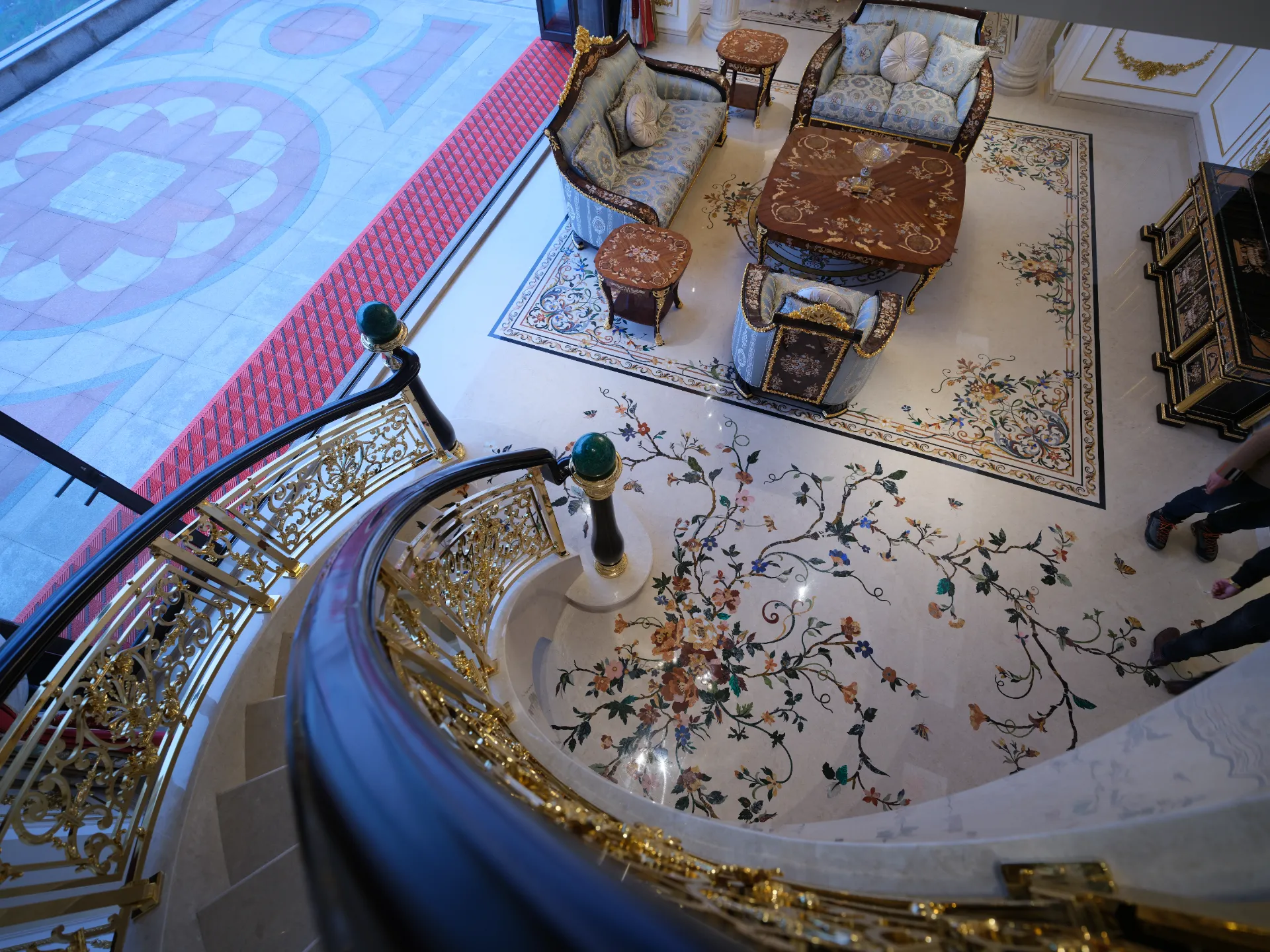
The term covers two related things. In the broad sense it means any work in hard, semi-precious stone. In the specific sense, the one used by collectors, it means commesso, the Florentine technique of composing a pictorial panel from stones chosen for their natural colour and veining, then closing the joints so tightly the panel looks like a single polished surface. The picture is not painted or printed on the stone; it is the stone, selected piece by piece.
A short history
The technique was refined in Rome in the sixteenth century and perfected in Florence under the Medici, whose Galleria dei Lavori became the Opificio delle Pietre Dure, still a name in the craft today. From Florence it spread to the royal workshops of Europe: cabinets, tabletops and chapel panels in lapis, malachite and jasper became the most prized objects of the Baroque. The same instinct, building an image from cut hardstone, appears in Mughal parchin kari, notably the Taj Mahal, and in later European tabletop work. What unites them is the material approach: choose the stone for the vein, then cut to the drawing.
Pietre dure vs mosaic
The difference is method, not scale.
- Mosaic uses many small, roughly uniform pieces (tesserae) set with visible grout or mortar between them.
- Pietre dure cuts larger, individually shaped pieces to a drawing and fits them so the joints close to a hairline, roughly 0.8 mm, then polishes the whole panel as one surface.
The result of pietre dure is a design that reads as continuous stone; the result of mosaic is a design built from visible pieces. Neither is better, they are different languages.
The stones used
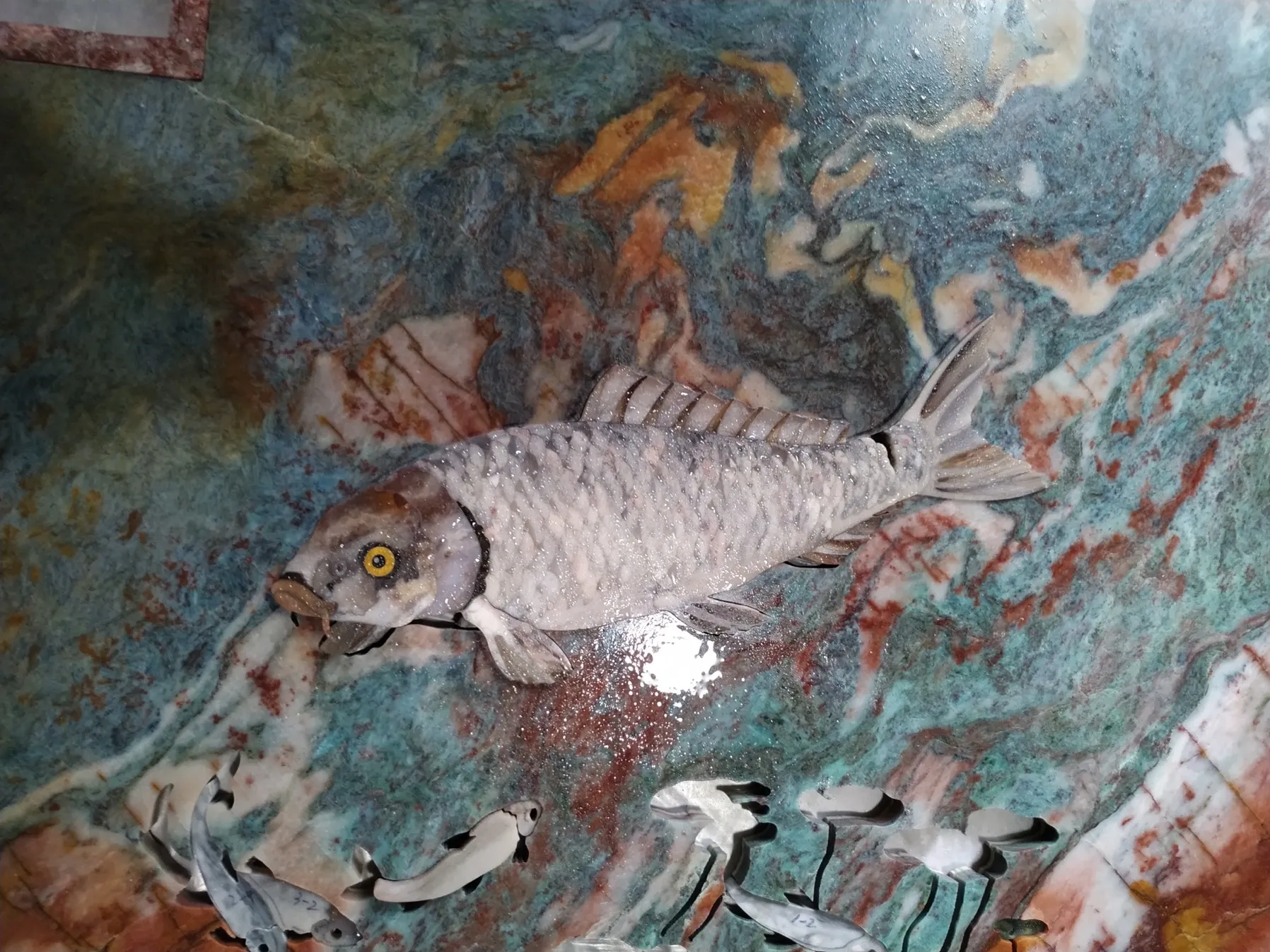
Semi-precious hardstone gives pietre dure its palette: lapis lazuli for blues, malachite for greens, jasper and agate for reds, browns and banded figures, onyx for translucency, mother-of-pearl for lustre, alongside marbles such as Calacatta and Nero Marquina. Each stone is chosen for the vein that will read as shadow, plumage or petal, so the picture emerges from the natural figure of the material rather than from applied colour.
How pietre dure is made today
Traditional pietre dure was cut entirely by hand with a bow saw and abrasive. Modern ateliers keep the handwork, the selection, the fitting, the closing of joints, but cut the pieces on a multi-axis waterjet from an approved CAD drawing. That gives the precision of machine cutting (±0.1 mm) with the judgement of the bench: the stones are still chosen against the drawing, the panel is still dry-assembled and photographed for approval, and the joints are still closed by hand. See waterjet marble cutting.
Where pietre dure is used
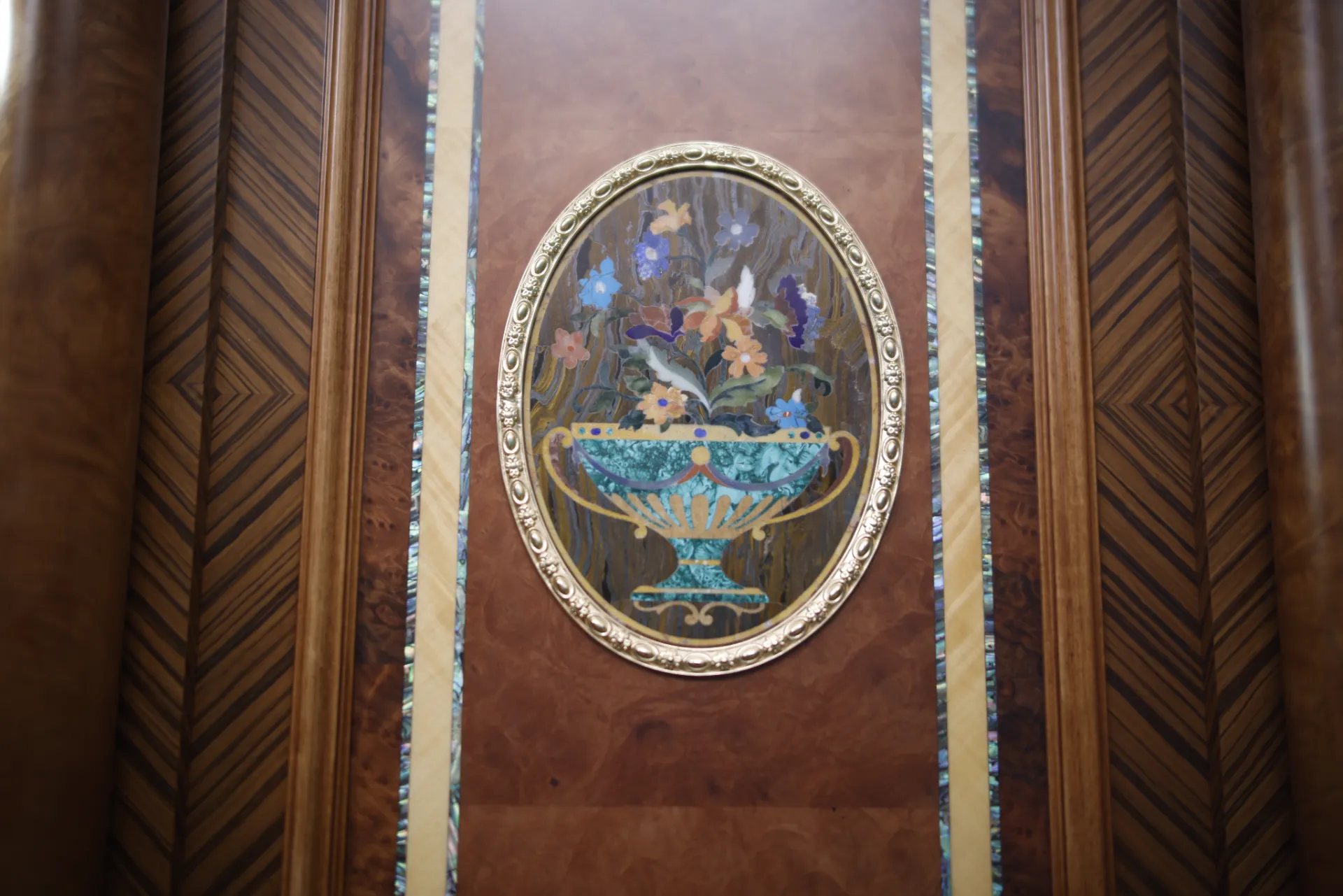
Because it is slow and material-intensive, pietre dure is reserved for focal points: a feature wall or entrance panel, a framed cartouche, a table top, a chapel or gallery panel, or an inlaid medallion. It ages beautifully, the colour and figure are inherent to the stone, not applied, and it is often the single most memorable element in a space.
Frequently asked questions
Is pietre dure the same as marble inlay?
Pietre dure is a form of inlay, but a specific one: pictorial work in semi-precious hardstone. Marble inlay more broadly includes floors, borders and geometric patterns.
Why is pietre dure so expensive?
The stones are costly and slow to work, and a single panel can hold thousands of individually fitted pieces. It is the most labour-intensive inlay there is.
Can pietre dure be used outdoors?
Some hardstones can, but it is normally kept indoors where the finish and stone are protected.
How is it cleaned?
As polished stone, a pH-neutral cleaner and a soft cloth; see our maintenance guide.
Commissions
Start a pietre dure commission
Send a drawing or a photograph, we return a technical material study, a cut plan and an itemised quote within three working days.